Why This Black Friday’s “Record” Is Actually a Warning Signal

Happy Cyber Monday!
Today is the day that everyone goes back to work – and starts scouring the internet for deals on holiday shopping.
If that’s the case, we could have a powerful trade setup.
If you read the Black Friday headlines this weekend, you probably saw the same message recycled over and over again:
“Record-Breaking Black Friday!”
“The Consumer Is Back!”
“Spending Surges!”
On the surface, sure – it looks like the American consumer is alive and healthy and ready to keep the spending going.
After all, according to Adobe Analytics, U.S. consumers spent a record $6.4 billion online on Thanksgiving itself, up 5.3% from a year ago.
Mastercard SpendingPulse said U.S. retail sales rose 4.1% compared with Black Friday 2024.
But peel back the veneer… and the story changes from a celebration of consumer strength to a stress signal.
The “Record” That Isn’t a Record
According to Salesforce, despite the strong sales numbers you just read above, shoppers actually bought fewer items per checkout than last year.
In other words…
Retail sales totals went up…
But the actual amount of stuff people bought went down.
This wasn’t a boom in demand – it was a boom in prices.
So, what did this weekend actually prove?
People are paying more to buy the same – or less.
That’s not a strength.
That’s inflation.
The Real Bombshell
Signs of inflation are enough to send shivers up anyone’s spine – especially those on Wall Street.
But the real problem is a new trend that American shoppers love…
Buy now, pay later (BNPL).
This impulsive, unhealthy, instant-gratification-enabling loophole saw spending hit $747.5 million in one day.
That’s 6.3% of all digital sales.
For Black Friday alone, that’s staggering – and it tells me one thing…
Households aren’t spending because they’re flush. Instead, they’re spending because they have access to one more line of credit.
Credit cards… store financing… “zero-interest” promotions…
We’re not watching a healthy consumer.
Instead, we’re watching a consumer stretching tomorrow to survive today – and retailers figuring out slick and creative ways to let it happen.
This is not “demand.” This is desperation disguised as tradition.
And as traders, here’s what we need to understand…
With every situation comes opportunity.
And right now, we have a big one setting up…
Target’s Pain = Amazon’s Gain
As we all know, it’s been rough sledding for Target lately – as bad management/bad messaging decisions have pushed the stock down 45% over the last 5 years.
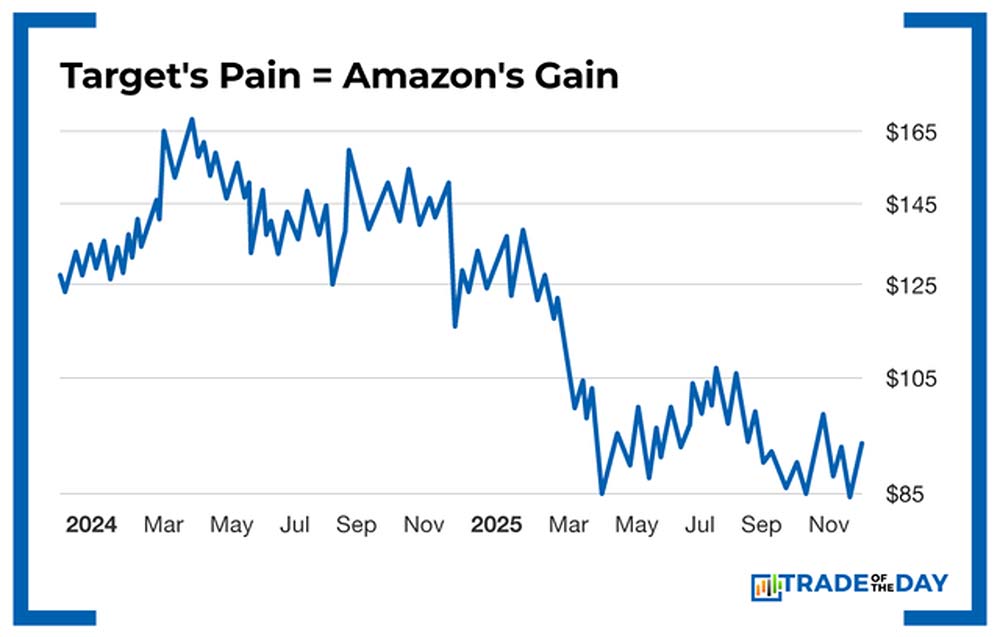
As the holiday shopping season now gets into high gear, will Target’s ongoing pain mean more opportunity for competitors – namely, Amazon?
That’s a trend that I’d like to zero in on in December.
JPMorgan estimates that e-commerce spending will increase 7% this season. Amazon already controls 46% of the e-commerce market.
If this already substantial lead grows even more, it could be time to get positioned in AMZN for a December run.

YOUR ACTION PLAN
E-commerce plays that don’t rely solely on BNPL models could emerge as the dominant winners here in December, which is something I’m exploring right now on our live trading site, The War Room.
More from Trade of the Day

Gold Just Went on Sale – But the Reason Won’t Last
Jul 17, 2026
The Market Feels Different. Here’s What To Watch.
Jul 16, 2026
Saddle Up Sally! The Hottest Trend in Retail
Jul 15, 2026