Huge News for Traders Everywhere

Editor’s Note: Join Karim and CJ on Wednesday, April 22, at 2:00 p.m. ET to see how put selling shifts the focus from price to probability and income, especially during earnings season.
Add this event to your calendar now! Click here.
– Bryan Bottarelli, MTA Co-Founder
The SEC just eliminated the $25,000 pattern day trading requirement.
I’ve been complaining about this for years. Last week, finally, it got fixed.
Here’s the quick background…
The pattern day trader rule was created in 2001 after the dot-com crash. Regulators decided that anyone making four or more day trades in five business days needed to maintain $25,000 in their account or face restrictions.
It was meant to protect retail traders from themselves, but what it actually did was lock out millions of smaller investors from actively trading their own money.
That changes now. The SEC approved the elimination of the rule on April 14.
The $25,000 requirement is gone. Day trades will no longer be counted. Brokerages will monitor risk exposure in real time instead of penalizing traders for how frequently they trade.
Traders of all account sizes can now react to markets the way professionals have always been able to… and make the trades they want to make. It’s a win for all traders.
But an even bigger winner is already emerging: Robinhood (HOOD).
Here’s why this matters specifically for HOOD…
Robinhood’s entire business is built around the smaller retail trader. The average customer account balance is well below $25,000.
The PDT rule was hitting HOOD’s core demographic harder than any other brokerage.
With the rule gone, that friction disappears. The traders who were most restricted, Robinhood’s exact customer base, can now trade freely. That means more activity, more volume, and more revenue for Robinhood’s platform.
The numbers already reflect the strength of this business. Robinhood ended 2025 with record annual revenue of $4.5 billion and net income of $1.9 billion.
Total platform assets sit at $314 billion across 27.4 million funded customers.
The number of gold subscribers, HOOD’s premium tier, is up 58% year over year. The prediction markets segment, a product that barely existed a year ago, is growing at 286% annually.
This rule change does not just help Robinhood at the margin. It removes the biggest structural barrier to growth in their target market.

YOUR ACTION PLAN
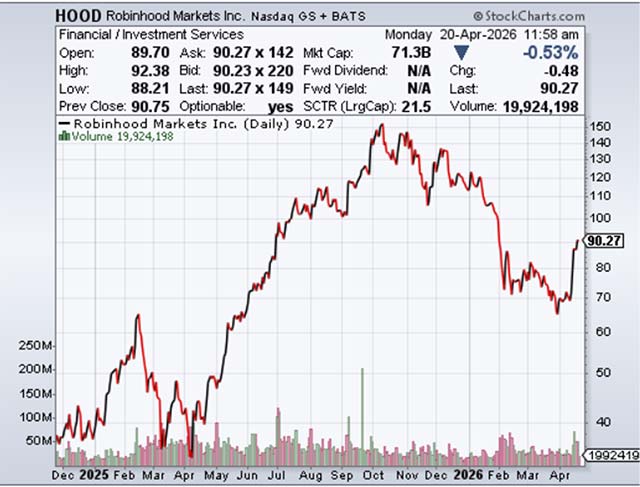
You can see how the stock moved sharply higher off this news last week.
I think the upside could easily continue. As new traders trade more frequently without having to maintain a $25,000 account balance, HOOD could easily return to $100 per share and above.
One more catalyst worth noting: HOOD reports Q1 2026 earnings on April 28 – just eight days from now. Wall Street consensus sits at $103.77.
That is another potential leg higher right around the corner.
Given this new rule, I consider HOOD a buy on any dips back into the $80s.
More from Trade of the Day

Gold Just Went on Sale – But the Reason Won’t Last
Jul 17, 2026

The Market Feels Different. Here’s What To Watch.
Jul 16, 2026

Saddle Up Sally! The Hottest Trend in Retail
Jul 15, 2026