The Off-Price Retailer That Turned Tariffs Into a Competitive Weapon
Burlington’s (BURL) CEO walked into 2025 with one stated goal on tariffs. We are not going to let them set us back.
When tariffs hit, management cut inventory in the most exposed categories, shifted the assortment toward apparel, footwear, and beauty, and reduced costs aggressively across the business.
Operating margin expanded 80 basis points. The CEO called the response spectacularly successful on the March earnings call. Off-price retail has a structural advantage when consumers feel economic pressure, and right now that pressure is real.
When full-price stores raise prices to offset tariff costs, Burlington’s 60-percent-off model gets more compelling with every passing month.
The business operates 1,212 stores across 46 states, selling branded merchandise at up to 60 percent off regular retail prices.
It generates $11.5 billion in annual net sales and plans to open 110 net new stores in 2026, rebuilding its home and holiday assortments to make year-over-year comparisons easier after deliberately pulling back last year to protect margins.
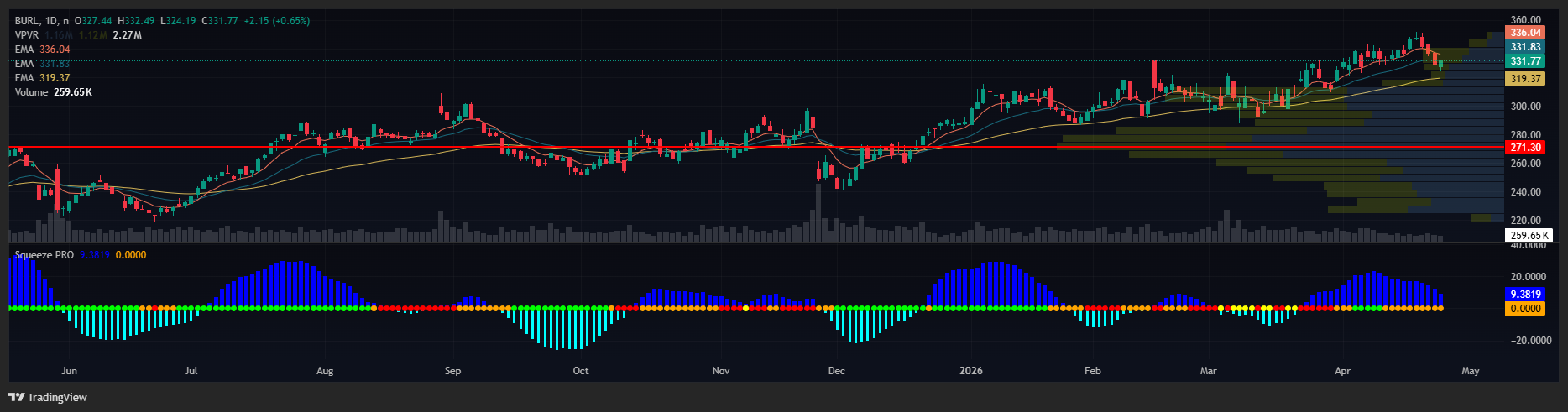
Shares bottomed near $217 in December and have moved more than 50 percent off those lows.
Price has since pulled back and is sitting just below the 8-day EMA at $336, testing the 20-day EMA at $332.
The 200-day simple moving average, which tracks the average closing price over the last 200 sessions, sits at $288. That structure holds across both the daily and weekly timeframes, with both confirming the trend is intact.
What has my attention is the squeeze forming on the daily chart. When Bollinger Bands compress inside the Keltner Channels, it means volatility is tightening. Price is coiling.
When it releases, it moves fast. Burlington is showing a low compression squeeze in its early stages right now. RSI is at 51.86, building without being stretched into overbought territory.
Burlington carries meaningful debt with a debt-to-equity ratio above 3. The home and holiday categories being rebuilt are the most exposed if tariffs escalate further.
The stock has already moved significantly from its lows, and a break below the 20-day EMA at $332 on volume would tell me the stacked structure is breaking and the setup needs reassessment. Q1 fiscal 2026 ends May 2nd with earnings expected in late May before the open. Do not size aggressively until we see how the market reacts to that report.
Your Action Plan
Watch for the price to hold the 20-day EMA at $332 on any further pullback. The trigger is a clean daily close back above the 8-day EMA at $336 on volume.
That confirms the pullback is over and the squeeze is ready to fire. If it fires while the price is back above both moving averages, that is the setup at full strength. If price breaks $332 on a closing basis, step aside and wait for a new base to form.
With earnings coming in late May, there is another layer to this setup. After a strong earnings print, stocks tend to drift higher in the weeks that follow. It is called earnings drift, and it is one of the most consistent patterns in the market right now. I will be watching for it here. If you want to understand how to trade it, check it out here.
More from Wake-up Watchlist



Healthcare Is No Longer Dead Money.
Jul 23, 2026

3 Stocks At All-Time Highs Just Got Downgraded
Jul 22, 2026