Inflation Is Especially Scary for These People

Editor’s Note: Today’s article comes from our friend Matt Benjamin of The Oxford Club. In it, he reviews inflation numbers from June and July, with a focus on one particular group of Americans who are being hit especially hard. As a Trade of the Day reader you will want to read what Matt has to say below.
-Ryan Fitzwater, Associate Publisher
June’s inflation number was pretty scary.
Consumer prices rose 9.1% in June year over year.
That was a four-decade high and significantly higher than the 8.8% rise that economists expected.
The consumer price index was also 8.5% in July – lower than June’s figure but still far above the Fed’s target level.
And that higher-than-expected number is certainly concerning for investors…
It will likely keep the stock market subdued for a little while longer – until investors see some light at the end of the rate-hiking tunnel.
But there’s one group of Americans for whom the inflation data will likely be even scarier…
Those who recently quit their jobs.
I wrote about this group last November (read the piece here), when labor market analysts first documented a trend of Americans quitting their jobs en masse, some to find a better situation and some to stop working altogether.
This phenomenon was even given a name: the Great Resignation.
And it’s more pronounced today than it was late last year.
Some 20.4 million Americans quit their jobs between January and May of this year, well above the 17.1 million who quit during the same period last year.
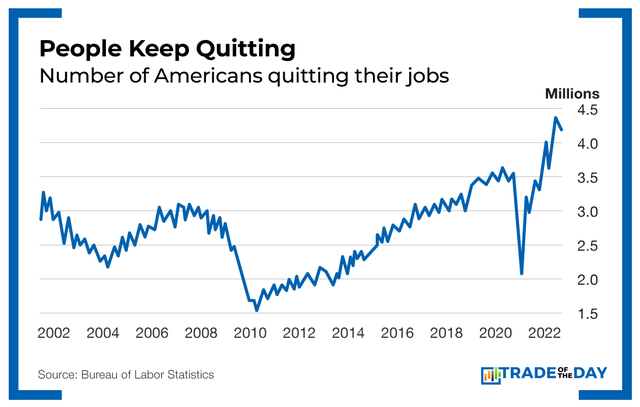
And it looks like the number of resignations this year will eclipse the 38 million we saw in 2021. That would set a new record.
According to the Pew Research Center, the most cited reasons for quitting were low pay, no opportunities for advancement and feeling disrespected at work.
Quitting for Good
Many who quit went on to find new jobs, of course.
But many others didn’t. You can see that in the labor force participation rate, which is the portion of Americans 16 and older who are working or looking for work.
Millions of Americans have completely dropped out of the labor force in the past few years – they’re not working and they’re not looking for work. That has pushed the labor force participation rate down to a level not seen since 1977, before women working became the norm.
Economists would say these people are choosing leisure over income.
But there is a current of thought coursing through the media that holds that capitalism is not “a functioning economic system,” that America is “an inescapable web of scams” and that hard work is “a propaganda slogan.”
If that’s what you truly believe about work, then I suppose it makes sense to quit completely.
But be warned: You may regret it.
According to a recent survey by job-search platform Joblist, the Great Resignation is causing great regrets.
The survey of 15,000 people found that more than 1 in 4 job quitters regretted their decision. And more than 4 in 10 who found a new job said it didn’t live up to their expectations.
In addition, so-called unretirements are on the rise, according to Joblist. More than a quarter of those who decided during the pandemic to retire early are reentering the workforce because of money concerns. Six in 10 said they’re just looking for something to do.
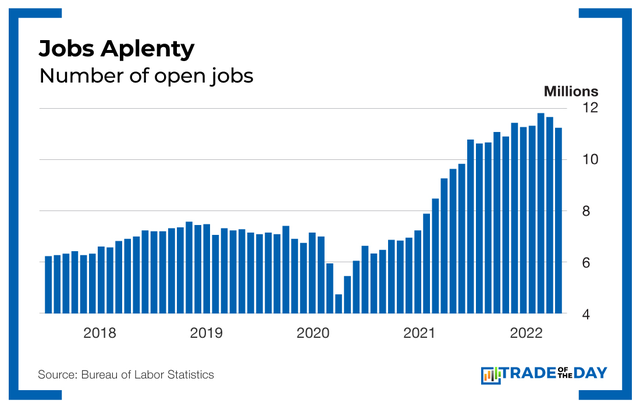
Luckily for these financially strapped and/or bored Americans, there are plenty of jobs to be had – about 11.4 million of them at the moment, in fact. That’s very close to the record 11.9 million openings in March.
The U.S. economy also added 528,000 jobs in July, meaning the labor market is remaining resilient.
But that resilience may not last – and the huge number of additional jobs will only make the Fed more aggressive, putting those out of work in additional danger.
One of the reasons for the elevated inflation we’re seeing now is that employers are scrambling to fill those 11.4 million job openings because there are only 5.9 million people looking for work at the moment.
To compete for those individuals, companies are finding they have to raise wages and provide more benefits. Average hourly earnings went up 5.1% in June, much higher growth than we saw before the pandemic, when earnings were growing around 3% a year.
That’s expensive. And to offset it, companies are raising prices. This is the familiar wage-price spiral that central bankers have nightmares about.
To end that vicious cycle, the Federal Reserve has made it quite clear it’s willing to sacrifice both earnings growth and employment growth.
If the Fed can bring that 11.4 million job openings number closer to the 5.9 million Americans looking for work – or even below it – then it can break the wage-price spiral.
That means, however, that jobs will be harder to come by, will be more competitive to land and won’t pay as much.
So unretiring now – before the Fed has achieved its goal – might be a very good idea. You’re much more likely to remain employed than to find a new job.
Those who remain unemployed may be left out in the cold.
Invest wisely,
Matt
Action Plan: With inflation continuing to be an issue, you need to know where the best investment opportunities lie. At Monument Traders Alliance, we analyze the market and isolate the top trades every day in The War Room. Our strategies have led us to a 76% win rate overall in 2022.
More from Trade of the Day

Gold Just Went on Sale – But the Reason Won’t Last
Jul 17, 2026
The Market Feels Different. Here’s What To Watch.
Jul 16, 2026
Saddle Up Sally! The Hottest Trend in Retail
Jul 15, 2026