NVIDIA Had Its Moment. Here’s What’s Next

The biggest fortunes in a technological revolution are rarely made by owning yesterday’s bottleneck. They’re made by identifying tomorrow’s.
The Rise of NVIDIA
Five years ago, the bottleneck in artificial intelligence was compute. If you wanted exposure to AI, you bought NVIDIA (NVDA). The company built the engine that powered the AI revolution, and the market rewarded shareholders accordingly.
Today, I no longer believe NVIDIA offers the same asymmetric risk/reward opportunity it once did.
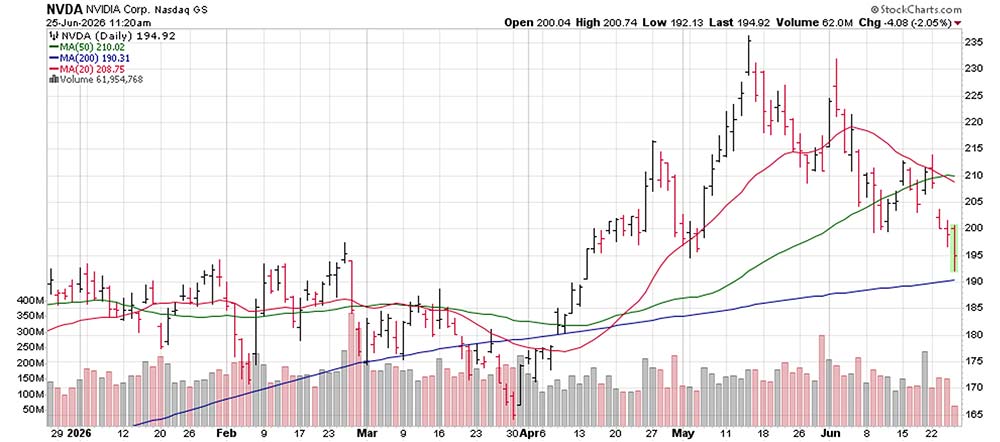
Just look at the stock today, trading 17% off its May highs, putting it at risk of falling into a technical bear market.
That isn’t a criticism of NVIDIA.
The company remains the dominant force in AI computing, and demand for its GPUs continues to be extraordinary. But markets don’t reward investors simply for buying great companies. They reward investors for identifying where capital is flowing next.
I think that next opportunity is beginning to move beyond the chip itself.
Micron’s (MU) latest earnings may have provided the first clue.
While NVIDIA recently delivered revenue growth of roughly 85%, Micron reported memory revenue growth of approximately 345%.
That’s not an indication that memory has become more important than AI processors. It’s evidence that the AI value chain is expanding as the infrastructure buildout accelerates.
Industrial Evolution
Think about the automobile industry.
When the first automobiles rolled off the assembly line, the engine was everything.
The internal combustion engine was the revolutionary technology that changed transportation forever. Investors didn’t care about the transmission, the wiring, the suspension or the tires because none of those components mattered without the engine.
That was NVIDIA.
The GPU was the scarce asset. If you owned the company building the engine, you owned the AI trade.
But industries evolve.
Eventually, every major automaker learned how to build a great engine. The engine never stopped being important, but it stopped being the only place where investors could create outsized returns.
AI is reaching that point today.
NVIDIA is no longer alone.
AMD continues expanding its AI platform. Broadcom (AVGO) has become a major supplier of custom AI silicon. The hyperscalers are designing proprietary chips. Even Intel (INTC) remains committed to competing in the AI processor market.
The engine is still essential, it just isn’t the only part of the car worth owning anymore.
Think about a typical SUV. The engine accounts for roughly 10% of the vehicle’s total cost.
Why would you focus exclusively on 10% of the vehicle while ignoring the remaining 90%?
That’s where I believe investors should be looking, the 90%.
Invest in the Car, Not the Engine
Memory has become the transmission of AI.
Every advanced processor requires enormous amounts of high-bandwidth memory to perform efficiently, and Micron’s results demonstrate how valuable that component has become.
Networking equipment is another opportunity. So are cooling systems, transformers and electrical infrastructure. Every one of these industries benefits as hyperscale companies race to build the next generation of AI data centers.
But if you’re looking for the most overlooked opportunity in the AI buildout, I think the answer may be fiber.
Every AI data center is built around communication.
Tens of thousands of GPUs must continuously exchange data with one another at extraordinary speeds. Those processors don’t simply sit inside a server rack performing calculations independently. They operate as one massive computing system.
That system depends on optical fiber.
Every new AI cluster requires an expanding network of fiber connecting servers, storage arrays, networking switches and communications equipment. As AI models become larger and GPU clusters continue growing, so does the amount of optical infrastructure required to support them.
Think of fiber as the interstate highway system for AI.
The world’s most powerful engine has very little value if it never leaves the garage. AI processors are no different. Without high-speed optical connections, they become isolated chips instead of one coordinated computing platform.
That’s why I find Corning (GLW) so interesting.
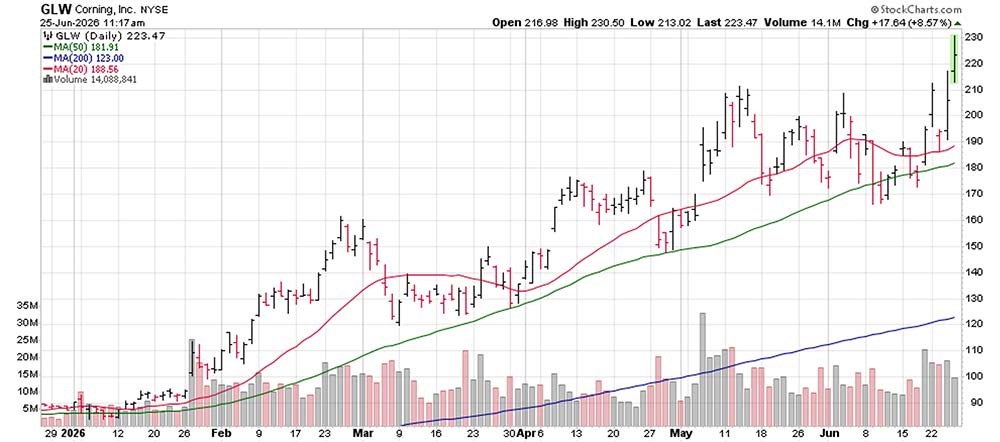
Corning isn’t competing with NVIDIA or Micron or DELL.
It isn’t trying to design the next AI accelerator.
Instead, it supplies one of the most critical pieces of infrastructure required for every AI data center being built around the world.
And that’s exactly where I want to be looking.
Going back to the auto analogy, how much wire is running through your car? Now scale that to a data center.
Starting to get the picture?
NVIDIA is approaching a $5 trillion valuation because investors understand AI compute.
But ask yourself a different question.
How much time is Wall Street spending thinking about the companies supplying the thousands of miles of fiber, the optical connectors, the cooling systems, the transformers and the electrical equipment required to make every AI data center function?
Those companies don’t generate the same headlines.
They don’t dominate conversations on CNBC.
Retail investors aren’t piling into them the way they chase AI chipmakers.
And that’s exactly what makes them interesting.
I’ve always believed the best investment opportunities come from following capital flows rather than headlines. Today, billions of dollars are being invested not only in AI chips, but in everything required to make those chips useful.
Five years ago, the engine was the investment because very few investors understood what AI computing would become.
Today, everyone understands the engine.
The next asymmetric opportunity isn’t likely to be found under the hood.
Investors are still staring at the engine.
I’m more interested in the companies building the roads.

YOUR ACTION PLAN
The investors who made fortunes in the automobile era weren’t the ones still debating which engine was best. They were the ones who looked up and saw everything else the car needed to run.
That’s exactly the kind of thinking JC Parets and Bryan Bottarelli brought to yesterday’s AI Dark Money event… identifying where capital is quietly flowing in the AI buildout before the headlines catch up.
If you missed it, the replay is available now. This is the part of the AI trade most investors aren’t watching yet.
More from Trade of the Day

Gold Just Went on Sale – But the Reason Won’t Last
Jul 17, 2026
The Market Feels Different. Here’s What To Watch.
Jul 16, 2026

Saddle Up Sally! The Hottest Trend in Retail
Jul 15, 2026