The War Premium Is Draining Out of Travel Stocks

The ceasefire with Iran is holding, and money is already moving.
The Strait of Hormuz is open again, and the war premium that sat on top of every barrel of oil for four months is draining out fast. When that premium goes, it lands hardest on the stocks that got hit hardest on the way up: airlines and cruise lines.
I have watched this exact setup pay off before, and I do not intend to miss it this time.
The war did real damage to these companies. Fuel is the single biggest variable cost an airline or a cruise operator carries, and the conflict sent it through the roof.
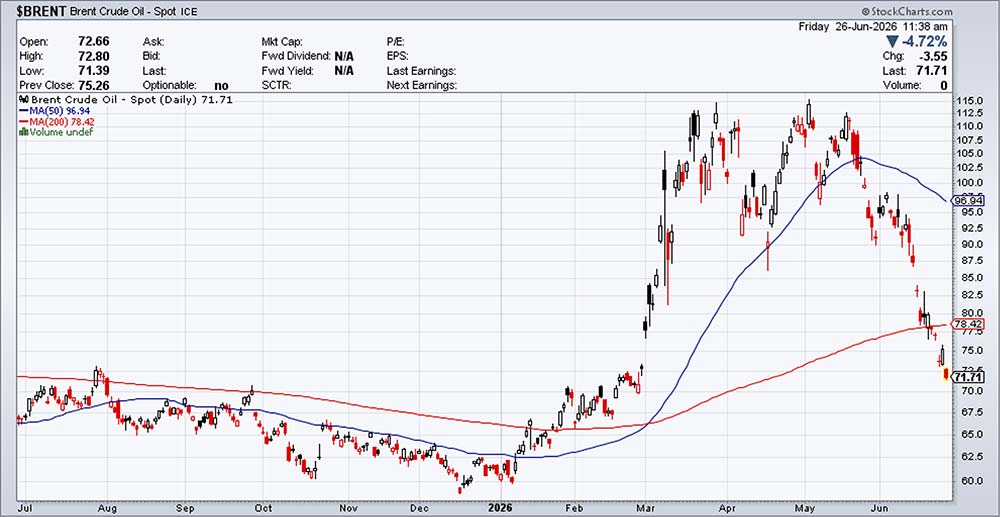
Brent crude ran from about $73 a barrel before the war to a peak near $126 in late April, the highest in four years.
Jet fuel went from $2.50 a gallon to $4.88. American Airlines (AAL) alone took a $400 million hit to a single quarter.
United (UAL) told Wall Street it was staring down $4.6 billion in added fuel costs. That’s the kind of number that forces airlines to cut flights and bleed margin, and that’s exactly what they did.
Now flip the whole thing over.
With the ceasefire holding, Brent has fallen back into the low $80s and is still heading lower toward that pre-war $73 level. Jet fuel is already back under $2.85 a gallon.
The crushing cost just got cut nearly in half, and demand never slowed. Travelers kept paying up all through the war, which means the airlines never had to drop their fares to match.
So now you have premium ticket prices on one side and collapsing fuel costs on the other, and every dollar of that spread drops straight to the bottom line.
Cruise lines have it even better over the long haul.
Those heavy ships burn bunker fuel by the ton, so a drop in oil flows right into their cash flow.
The reopening of the shipping lanes also clears out the reroutes and the itinerary headaches that the war forced on them earlier this year. And the demand is real.
Data from the Conference Board shows consumer spending shifting hard out of physical goods and into experiences, with intended vacation and cruise spending hitting multi-year highs.
The big operators are reporting record booking volumes at the same moment their heaviest cost is falling.
There’s one more leg to this, and it’s the highest-margin one.
War kills international travel, plain and simple.
Nobody books the long-haul corporate trip when there’s a shooting war near the route. With the ceasefire in place, that traffic comes back.
According to analyst data from Cerity Partners, the peace deal means a fast resumption of the cross-border industrial ventures that got shelved during the conflict, and that brings back the passenger an airline loves most: the business-class corporate flyer.
Currency markets have settled, the tourism corridors are reopening, and it’s all landing right before peak travel season.
Add it all up. Fuel costs are falling, margins are expanding, and the highest-paying customers are coming back, all at once. The market has already given you a preview.
The session the peace deal hit, airlines and cruise lines jumped 4% to 10% in a single day.
That was just the opening move.
Wall Street is slow to rework its Q3 and Q4 earnings models, so the real repricing hasn’t happened yet. The gap between where these stocks sit today and where the numbers say they are headed is still wide open, and it is closing by the week.

YOUR ACTION PLAN
In the next issue of Monument Trend Advisory, I’ll dish out my two top picks in this sector and, more importantly, show you how to buy them at lower than market prices.
 |
FUN FACT FRIDAY
Jet fuel is often cheaper per gallon than the gasoline you put in your car (and sometimes even cheaper than diesel), despite being a highly refined, safety-critical product for high-altitude use.
Jet fuel (Jet A/Jet A-1) is basically a close cousin to kerosene or diesel, refined to strict specs for freeze resistance, thermal stability, and cleanliness at 30,000+ feet.
It benefits from massive economies of scale (airlines burn billions of gallons yearly) and can sometimes trade below road fuels before taxes and distribution.
So, despite what you may have thought, aviation fuel doesn’t always cost a fortune.
More from Trade of the Day

Gold Just Went on Sale – But the Reason Won’t Last
Jul 17, 2026

The Market Feels Different. Here’s What To Watch.
Jul 16, 2026

Saddle Up Sally! The Hottest Trend in Retail
Jul 15, 2026