Forget The Chips, Watch The Power Grid

Over 30 years ago, I watched the early stages of the Internet revolution unfold.
The technology itself wasn’t new. Semiconductor chips had been around for years, but reality had finally caught up with innovation. Personal computers were finding their way into homes and businesses, and investors quickly recognized that computing power was about to change the world.
The problem? Technology had reached a bottleneck.
I can hear the dial-up modem now.
A brick of hardware sitting on my desk.
The computing power and software were there, albeit slow.
The infrastructure wasn’t.
The Internet couldn’t become the Internet until millions of computers could communicate with one another quickly, reliably and at scale.
That challenge launched an entirely new investment cycle focused on networking equipment, routers, and the backbone that connected everything together.
One company stood squarely at the center of that transformation: Cisco Systems (CSCO).
Investors who recognized the networking bottleneck were rewarded in spectacular fashion.
Cisco shares exploded throughout the 1990s and, at the peak of the dot-com boom, Cisco briefly became the largest company in the world!
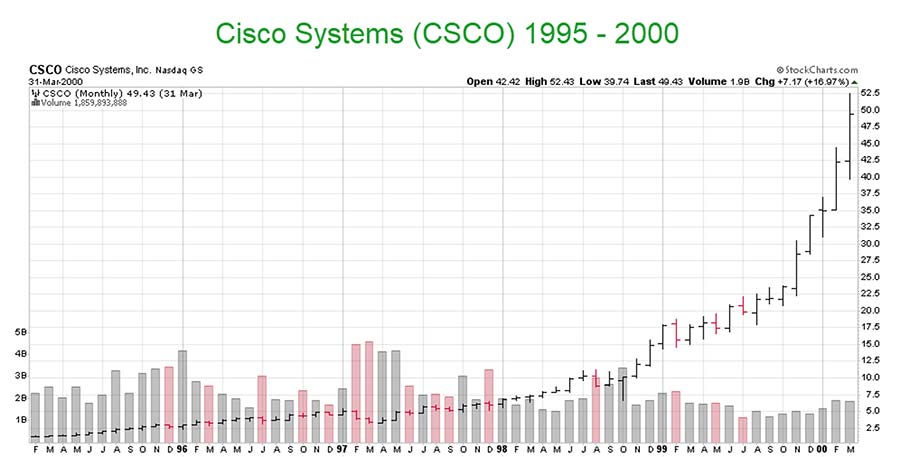
Not because it built the personal computer.
Not because it invented the Internet.
Because it solved the Internet’s biggest bottleneck.
We’re seeing the same story play out with AI. Who’s the next solution to the bottleneck?
Always Look for the Bottleneck
There’s a simple investing lesson that has repeated itself throughout every major technological revolution I’ve witnessed over the past three decades:
Every one creates a new bottleneck. Follow the bottleneck, and you’ll find the next generation of market leaders.
For the past two years, Wall Street has been building the AI engine.
NVIDIA (NVDA) grew historically because investors recognized that AI would require unprecedented computing power.
More recently, capital has shifted toward memory manufacturers. Some memory stocks have climbed more than 200% in just the past few months.
That’s because memory has become the short-term bottleneck.
Now it’s time to ask a different question.
Where’s the Next Bottleneck?
Energy.
The next phase of AI isn’t about making the engine more powerful. It’s about building the infrastructure that allows the engine to operate.
Tech companies aren’t building traditional data centers, they’re building what NVIDIA CEO Jensen Huang calls AI factories.
These facilities don’t simply store information. They continuously train large language models, perform inference, and manufacture intelligence around the clock.
That requires enormous amounts of reliable electricity, making energy one of the largest operating expenses in the entire AI ecosystem.
That’s where the investment story begins to change.
The semiconductor industry solved the compute bottleneck.
Memory manufacturers are solving the bandwidth bottleneck with more production.
The next challenge isn’t processing data. It’s supplying enough electricity to keep AI factories operating 24 hours a day.
The Problem With Energy
Unlike semiconductor shortages, this isn’t a problem that can be solved in a few quarters.
Expanding the electrical grid requires years of planning, permitting and construction. But AI demand isn’t waiting.
And bridging that gap in the short term will be natural gas…
But companies investing tens of billions of dollars into AI infrastructure aren’t making decisions based on next quarter’s earnings. They’re making capital allocation decisions that will determine operating costs for the next 30 years.
Karim talked about it in yesterday’s Trade of the Day… ladies and gentleman, nuclear.
According to the U.S. Department of Energy, nuclear power is significantly more energy-dense and reliable than natural gas. And it delivers more reliable power from a remarkably small amount of fuel over an exceptionally long operating life.
Those economics matter to the companies that are developing the AI Factories.
More importantly, the emergence of Small Modular Reactors (SMRs) creates an entirely new opportunity for hyperscale AI operators.
Rather than depending exclusively on utility companies and an aging electrical grid, SMRs create the possibility of generating electricity behind the meter, placing power generation directly alongside AI factories.
That’s an important distinction.
Owning the power source reduces transmission constraints, improves reliability, and gives operators greater control over one of their largest long-term expenses.
For companies investing hundreds of billions of dollars into AI, electricity isn’t simply another utility bill.
It’s a long-term margin decision, and that’s how these large tech companies think.
I’m not suggesting investors abandon semiconductor or memory stocks. Those trends remain intact.
But every major technological revolution eventually expands beyond its original breakthrough.
The Internet needed networking before it could change the world.
AI needs energy.
Wall Street spent the last two years rewarding the companies that built the engine. The next investment cycle may reward the companies building the infrastructure that keeps it running.

YOUR ACTION PLAN
Here are some AI bottleneck stocks to watch.
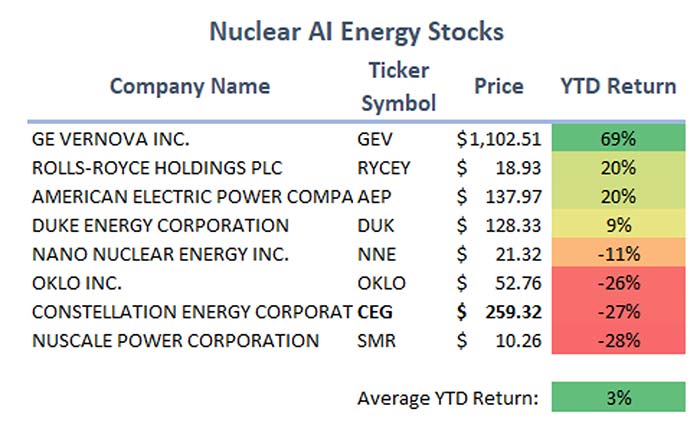
At one end are established utilities and power providers like Duke Energy (DUK) and Constellation (CEG), that are already working with hyperscale tech firms.
Further down the spectrum are companies developing the technologies that could define the next era of nuclear power.
Rolls-Royce (RYCEY), NuScale (SMR), and Nano Nuclear (NNE) are focused on advancing SMRs and other next-generation nuclear solutions. These companies carry considerably more risk, but they also offer greater long-term upside if SMRs start doing the heavy lifting.
Follow the bottleneck, and you’ll often find the watershed investment opportunity.
More from Trade of the Day

Gold Just Went on Sale – But the Reason Won’t Last
Jul 17, 2026
The Market Feels Different. Here’s What To Watch.
Jul 16, 2026

Saddle Up Sally! The Hottest Trend in Retail
Jul 15, 2026