Institutional Money Left These Stocks Behind… But It’ll Be Back

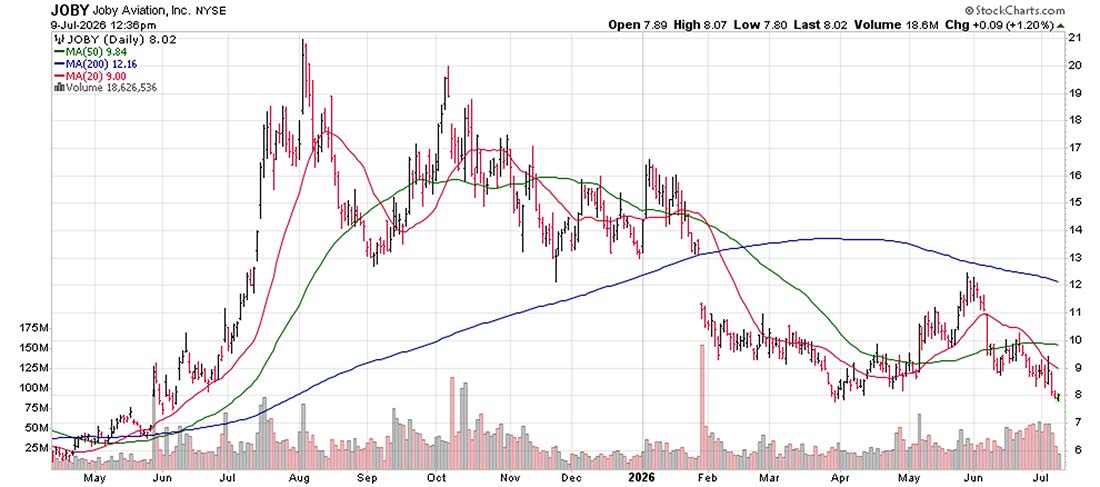
One of the best questions I received during yesterday’s Monument Traders Alliance LIVE session came from an investor asking whether Joby Aviation (JOBY) was worth buying.
The question from Steel: “Thoughts on JOBY long term?”
The short answer is “yes, it’s a buy.”
The longer answer has very little to do with Joby itself and everything to do with how institutional money moved through three emerging industries in 2025, taking them on a wild ride and then migrating back to the AI trade… for now.
What Happened in 2025
 |
I call Joby Aviation a “Jetson’s Stock”, IYKYK.
The company is developing electric vertical takeoff and landing aircraft, or eVTOLs, that could reshape regional transportation over the next decade.
Like most companies pioneering transformational technology, the opportunity is enormous, but that means meaningful profits are still years away.
That makes Joby a highly speculative investment.
More importantly, it makes Joby and other stocks like it highly dependent on institutional money.
Stocks like Nano Nuclear Energy (NNE), NuScale Power (SMR) and many of today’s leading quantum computing companies fit the description of “Jetson (or Discovery) Stocks”.
I group these industries into three themes: AI Nuclear, Quantum Computing, and eVTOL.
Although each serves a different market, they trade remarkably alike because investors value them the same way. Their earnings potential lies years into the future, so institutional capital and retail speculation, not quarterly earnings, is often the largest driver of price.
That’s why these stocks can double in a matter of months.
It’s also why they can lose 40% just as quickly.
During the April 2025 “Taper Tantrum,” the group of AI Nuclear, quantum computing and eVTOL companies that I monitor fell an average of 41%. Joby itself dropped from above $10 to nearly $5.
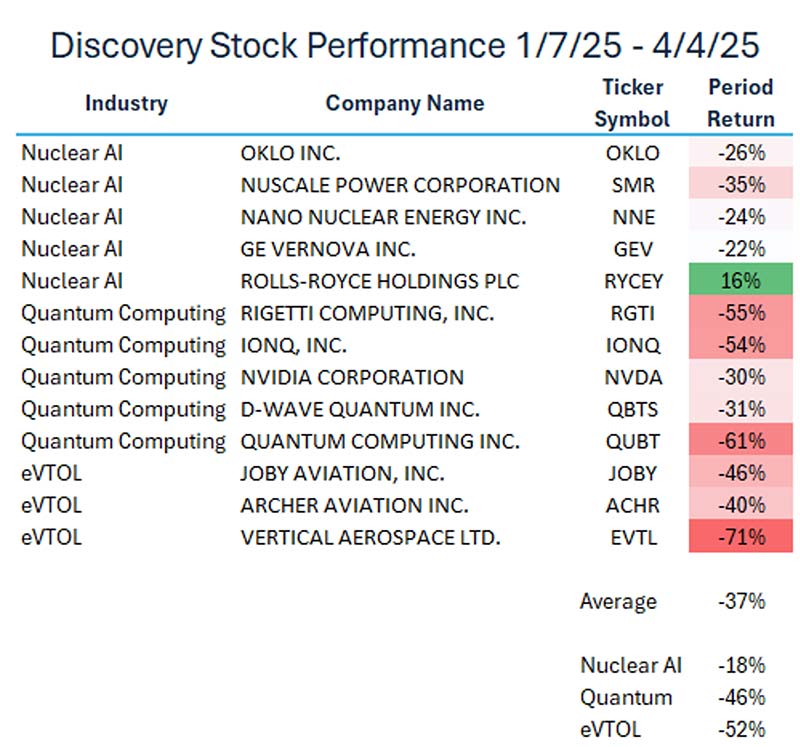
Nothing fundamentally broke.
Investors simply decided they no longer wanted speculative assets.
Here’s why…
Geopolitical uncertainty, tariff concerns, and broader market volatility caused institutional investors to reduce exposure to higher-risk companies. When portfolio managers become defensive, companies whose profits may still be five or ten years away are often the first positions to be reduced.
Then the market changed in April as the uncertainty surrounding tariffs was defined.
Confidence returned to the market, followed by institutional money flow into these stocks.
Within two months, the same basket of companies surged an average of 134%.
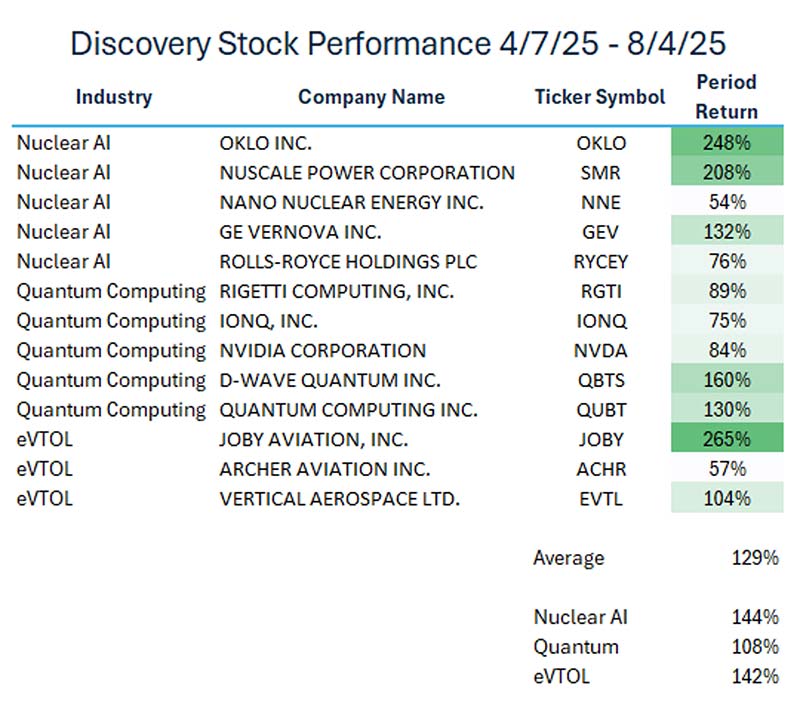
Retail investors participated, but they weren’t driving the move, simply riding the coattails of the big money. Sadly, that’s usually the case.
Average daily trading volume across these companies increased roughly 320% into the August highs. At the same time, unusually large option blocks began appearing across the group. Those are exactly the types of footprints I look for when institutional investors begin accumulating positions.
That distinction is critical because institutions rarely announce what they’re buying.
In fact, their objective is exactly the opposite. They accumulate positions quietly over weeks or months before Wall Street begins talking about the story.
By the time the headlines reach the financial media, much of the institutional buying has already taken place.
Why Were the Institutions and Retail Investors Buying?
The catalyst behind last summer’s rally was easy to identify.
The White House announced initiatives aimed at accelerating approvals for small modular nuclear reactors (SMRs) while several hyperscale data center developers discussed behind-the-meter nuclear power to support future AI infrastructure.
Those announcements reignited enthusiasm for AI Nuclear and spilled over into quantum computing and eVTOL as investors once again embraced long-duration growth opportunities.
But the same institutional money that created the rally eventually found a better opportunity.
And Just Like That…
Beginning in late July and accelerating through August, capital rotated into companies already benefiting from AI spending.
Memory manufacturers, networking companies, optical component suppliers and industrial firms tied directly to data center construction became the new destination for institutional capital.
Investors wanted companies producing AI revenue today rather than companies whose revenue growth had to wait a few years.
That rotation had nothing to do with the long-term potential of Joby, Nano, NuScale or any of the other Discovery Stocks.
The move reflected where institutional investors believed the next dollar would earn the highest return.
Today, many retail investors are chasing the same AI infrastructure companies institutions accumulated months ago.
Ironically, some of the AI Nuclear and Quantum Computing stocks the institutions left behind are becoming increasingly attractive again.
Government support for SMRs continues to expand. AI power demand continues growing. Utilities and hyperscale operators are pursuing nuclear partnerships at an accelerating pace.
Quantum computing continues advancing as government funding increases and commercial applications expand.
Joby continues progressing toward FAA certification while adding commercial and military partnerships.
The businesses have continued moving forward even while many of the stocks have remained well below their highs.
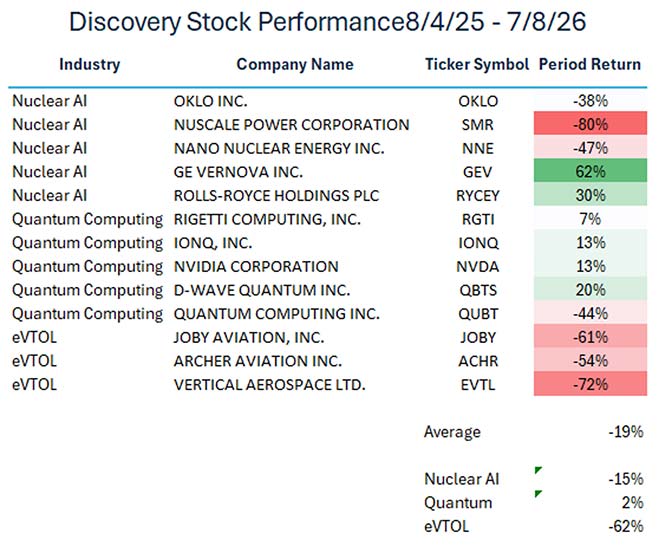
Institutional money doesn’t disappear. It rotates to the next opportunity.
Throughout my career, I’ve found that some of the biggest investment opportunities come from identifying where institutional capital is likely to rotate next, not where it rotated six months ago.

YOUR ACTION PLAN
Yes, AI Nuclear and eVTOL deserve a place on your watchlist right now.
The next meaningful catalyst won’t arrive with a press release announcing the buying has begun. Large money managers don’t broadcast their moves, they buy quietly while your attention is elsewhere.
By the time you’re paying attention, it’s too late.
More from Trade of the Day

Gold Just Went on Sale – But the Reason Won’t Last
Jul 17, 2026
The Market Feels Different. Here’s What To Watch.
Jul 16, 2026
Saddle Up Sally! The Hottest Trend in Retail
Jul 15, 2026