The Pentagon Just Made A $99 million Bet on One Defense Supplier
There’s a building in Herndon, Virginia, where engineers monitor satellites that the Pentagon now considers irreplaceable.
On March 31, the Department of Defense made it official.
The Pentagon awarded that company a $99 million multi-year contract without competitive bidding, solicitation from other vendors, or negotiation. One supplier got picked and signed the deal.
That kind of contract has a name. It’s called a sole-source IDIQ award, which means the Pentagon locked in one specific vendor for an indefinite-delivery, indefinite-quantity pool of work over a multi-year period without putting the contract out for competitive bidding.
That happens only when one supplier can do something no other vendor can match.
That is the strongest signal a defense contractor can get short of a classified award.
The company is BlackSky Technology (ticker: BKSY).
They build and operate satellites that capture 35-centimeter-resolution images of Earth and run them through AI to deliver real-time intelligence in under 40 minutes, used by defense customers to monitor ports, air bases, troop movements, and infrastructure.
Think of it as Google Maps if Google Maps refreshed hourly, focused on the spots where things matter, and ran computer vision on every frame.
The $99 million sole-source contract is not the only signal. It is the headline signal in a stack of them.
In April, BlackSky signed a $25 million multi-year “assured” contract with a major international defense customer, guaranteeing daily 35-centimeter imagery collection.
One $30 million one-year subscription contract started as a six-figure pilot just six months earlier. The CEO told the Q1 earnings call that the company has now booked roughly $160 million in contract awards year to date, with backlog at $380 million and about $90 million expected to flow into 2026 revenue.
Revenue came in at $20.8 million with $117.5 million in cash on the balance sheet, and management raised full-year 2026 guidance to $130-$150 million in revenue and $12-$24 million in adjusted EBITDA. CEO Brian O’Toole called the quarter an “inflection point” as the Gen-3 constellation moved into full operations with four satellites delivering daily revisit rates across key regions worldwide.
The stock has been reading the signal in real time.
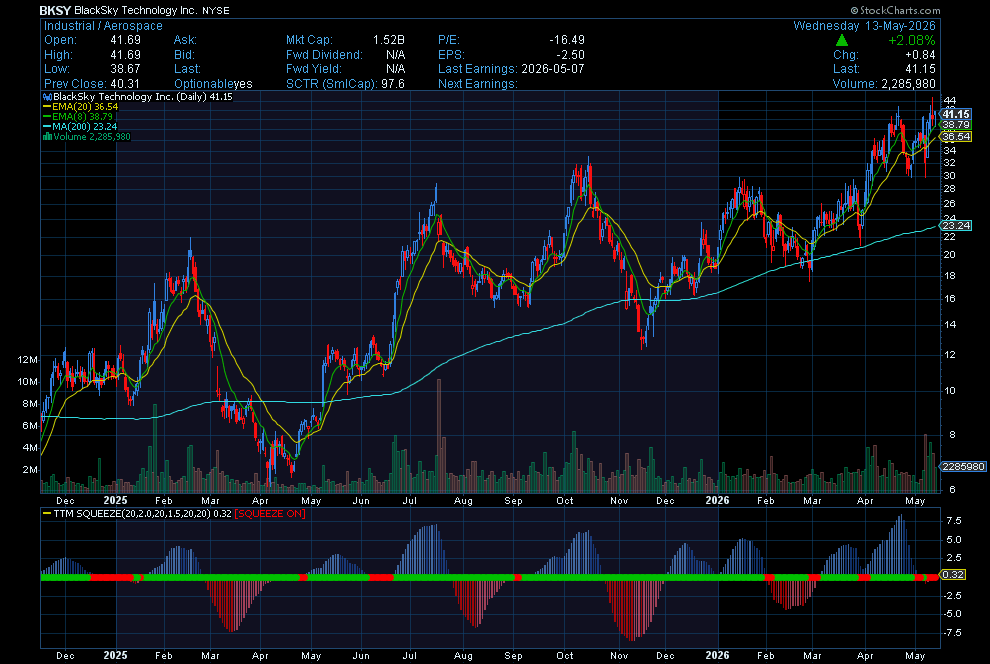
BlackSky is up 247% in the past year and 119% year to date, trading at $41 after touching $44.70 last week, with the chart sitting in tight consolidation right below that 52-week high.
This is exactly the TPS setup I look for.
The 8-day exponential moving average is above the 20-day, which is above the 200-day, and both the daily and weekly timeframes are stacked bullish. RSI is at 59 with plenty of room, and a daily squeeze is forming on the chart, which is the volatility compression I want to see before the next directional expansion.
The story is there, and the chart is setting up perfectly.
But I’m looking at this as more of a trade than an investment.
The reason is that the company is still posting losses, with an operating margin of negative 54%, and short interest is 22.7% of the float. This is a growth-into-profitability story, not a cash-flow story.
But the Pentagon doesn’t care about quarterly margins when it picks a sole-source supplier. The Pentagon cares about capability, reliability, and strategic positioning. They just made their bet visible.
Your Action Plan
When the Pentagon picks one supplier without putting it out for bid, that’s not a recommendation. It’s a vote of confidence backed by a budget.
When the federal government tells you who it picked, the question is whether you read the signal in time to take the same side.
The TPS setup is there.
Click here to see exactly what I'm trading and how I'm trading it.
More from Wake-up Watchlist



Healthcare Is No Longer Dead Money.
Jul 23, 2026

3 Stocks At All-Time Highs Just Got Downgraded
Jul 22, 2026