A $10.8 Billion Election Boom is Coming – This Stock is Ready

My favorite thing to do on my media trips to New York was simple. Not a fancy restaurant or show, but instead a routine that may feel out of date.
I’d fly in on Sunday morning, go straight to the hotel, grab a copy of the New York Times and a Snapple. Then I’d head to the middle of Central Park for an afternoon of reading and napping on one of the sprawling lawns under a tree.
It’s one of those visions that most people think is dead, which is why the New York Times was left for dead years ago.
But this media company is roaring as it sets up for what could be a 20-40% rally over the next six months.
It’s a hell of a contrarian setup that is getting ready to be fueled by a familiar seasonality cycle.
Here’s why…
Mid-Term Election Seasonality
Most investors focus on the presidential “election cycle” patterns in the S&P 500.
You know, a simple “the S&P 500 rallies X% in a presidential or mid-term election year.” It’s an oversimplification of the seasonality that really doesn’t help the average investors.
The cycle itself shouldn’t be ignored though.
Some of the best opportunities appear when investors take a logical Walk Down Main Street and identify businesses that directly benefit from the surge in political spending.
Traditional media companies sit directly in that path.
And one of the most overlooked names right now is The New York Times (NYT).
A Political Spending Boom Is Coming
The primaries are firing up, which means we’re going to start seeing advertisements all over the place again. Those ads represent revenue for the media companies, but it’s just the appetizer. The real meal is coming as the primaries turn to the election.
The 2026 elections are on track to become the most expensive midterm cycle in U.S. history.
According to AdImpact’s Political Projections 2025–2026 report, political advertising spending is expected to reach $10.8 billion, more than 20% higher than the 2022 cycle.
Campaigns are also spending earlier in the cycle, and they are spreading those dollars across more platforms like broadcast, digital, and connected TV.
That rising tide will lift the entire media ecosystem.
And while investors often assume the New York Times is no longer part of the advertising business, the numbers say otherwise.
The company generates roughly $500 million per year in advertising revenue across its digital and print platforms. Political ads account for $20 million to $50 million of that total in a presidential cycle. And that number is going up, fast.
But advertising isn’t even the biggest election benefit for the Times.
Elections Bring Subscribers
The real revenue surge during election cycles comes from reader behavior.
Political uncertainty drives traffic, and there is plenty of that going on right now. In turn, the increased engagement traffic drives subscriptions as readers go from casual to dedicated.
And the New York Times has built one of the strongest digital subscription businesses in media.
The company now has roughly 12.7–13 million total subscribers, with more than 12 million digital subscribers.
Note: why do I know this works? I restarted my home delivery and electronic subscriptions in 2020, ahead of the elections. Still one of the best subscriptions I maintain.
That growth is powered by the company’s bundle strategy, combining its news product with Games, Cooking, Wirecutter, and The Athletic. This ecosystem keeps users engaged and reduces churn.
According to the company’s latest earnings report, management’s long-term goal is 15 million subscribers by 2027, indicating continued growth ahead.
Investor Sentiment Towards NYT Is Surprisingly Bearish
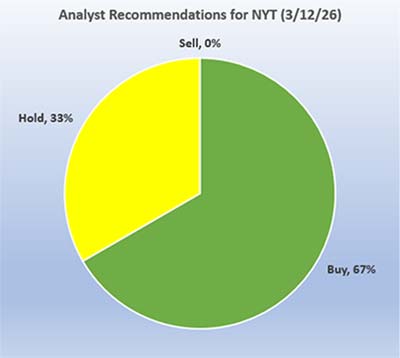 |
Despite these strong fundamentals, sentiment toward NYT shares remains surprisingly cautious.
Currently, 67% of Wall Street analysts rate the stock a Buy, while 33% rate it a Hold.
Compare that with the Magnificent Seven, where roughly 91% of analysts recommend buying, and it becomes clear that NYT is far from overcrowded with bullish sentiment.
Short sellers also remain active, creating potential for a bullish short squeeze rally.
The stock currently carries a short interest ratio of 4.4 days and 6.2% of the float sold short.
That level of pessimism can create a powerful technical catalyst.
If the stock continues rising, those short sellers will eventually have to buy back shares, creating additional upward pressure through a short squeeze.
The irony of that pessimistic picture is that NYT has been handily beating the broader market.
Shares are up 66% over the past year and more than 13% year-to-date, outperforming the average S&P 500 and Nasdaq 100 stock.
And investors remain skeptical? That’s going to change.
The Technical Picture Is Strong
The chart is where the real opportunity appears.
NYT shares are currently trading in a strong long-term bull trend that began in June 2023, when the stock crossed above its 20-month moving average.
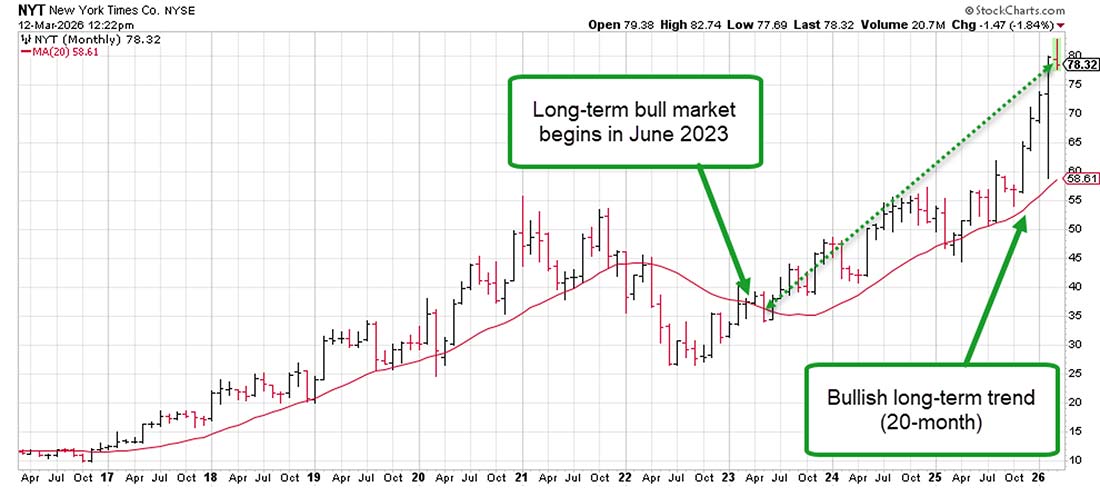
Since that signal, the stock has gained more than 100%.
Short-term technicals are equally strong.
The 50-day moving average is trending higher, providing support after the company’s most recent earnings report.
Despite delivering revenue and earnings above Wall Street expectations, the stock briefly dropped nearly 20% as investors reacted with a classic sell-the-news move.

That pullback quickly found support at both the 50-day and 200-day moving averages, creating one of the strongest buy-the-dip opportunities in the market over the past six months.
Shares have since recovered and are once again trading near all-time highs above $80.
The Bottom Line
The New York Times is quietly sitting at the intersection of two powerful trends:
- Rising political spending
- Growing digital subscriptions
At the same time, investor sentiment remains cautious and short interest is elevated.
That combination – strong fundamentals, strong technicals and pessimistic sentiment – is exactly the kind of setup real contrarian investors look for. The political spending seasonality only adds to the bullish catalysts for New York Times shares, increasing the likelihood that the media company’s stock will continue its strong bullish trend.
Recent short-term selling and profit-taking have resulted in the stock testing its 20-day moving average. That short-term trendline support should be viewed as an opportunity to grab shares ahead of its next run higher.
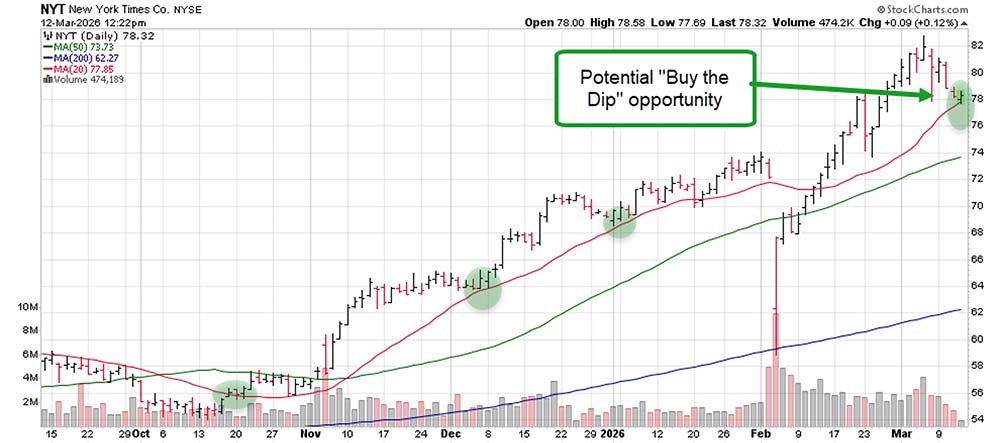
If the trend continues, NYT shares could easily add another 20% or more as the bears slowly turn into buyers.
More from Trade of the Day

Gold Just Went on Sale – But the Reason Won’t Last
Jul 17, 2026

The Market Feels Different. Here’s What To Watch.
Jul 16, 2026

Saddle Up Sally! The Hottest Trend in Retail
Jul 15, 2026