Get Paid Like Karim

Warren Buffett didn’t build his fortune chasing stocks, he built it by buying great companies at prices that represented extreme value.
That is the same principle behind the strategy I have been building out over the last few weeks.
I brought in Karim Rahemtulla to help me apply it.
He’s someone with over 30 years of experience who refuses to pay full price for anything. His approach is simple but powerful. Use put selling to generate income while naming the exact price you’re willing to pay for a stock.
You get paid to wait, positioning yourself to buy quality stocks at a discount or walk away with income if the opportunity never comes.
Today, I’m applying that framework to one of the most volatile and misunderstood sectors in the market right now…
Quantum computing.
The Quantum Setup
Last year, quantum computing stocks exploded. Names like IonQ, D-Wave Quantum, and Rigetti Computing surged 100% to 200% in a matter of months.
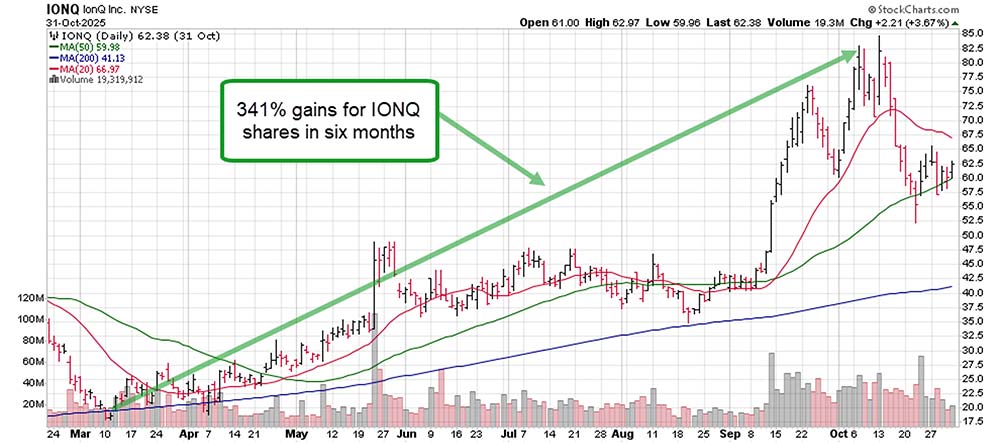
That move followed a pattern we have seen play out repeatedly throughout market history, from the dot-com bubble to the AI boom and now into quantum computing.
The early momentum phase is over.
The easy upside has already been captured. What we’re seeing now is a transition into the Awareness stage, a period where early capital quietly rebuilds positions before the broader market catches on. If history repeats, the next phase is public participation.
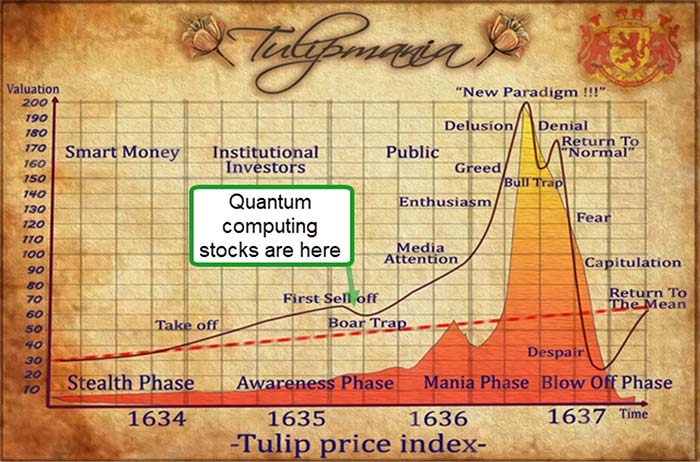
That’s when price accelerates quickly, sentiment turns euphoric, and late investors are forced to chase.
Most investors will wait for confirmation and buy when prices are already extended. I’m not doing that. I’m positioning now and getting paid to do it.
The Strategy: Get Paid to Wait
The goal is simple. Take advantage of large price swings and turn them into income opportunities. Volatility is the key input. Higher volatility drives higher option premiums. That’s what I’m targeting.
As you likely know by now, Karim’s put-selling strategy centers around selling deep out-of-the-money, long-dated puts, typically 25% to 50% below the current price, with expirations around six months out.
That distance matters. By pushing my strike price well below the market, I’m targeting levels where sentiment would likely be negative again, areas where fear replaces optimism. The longer duration allows the trade to work through volatility cycles while maximizing premium collected.
There are only two outcomes. If the stock never pulls back, the option expires worthless and I keep the premium.
If the stock does sell off, I’m assigned shares at a discounted price, which lowers my cost basis even further. Either way, I’m operating from a position of control.
Here is where the margin makes this even more interesting. Selling a put on a $20 stock using margin typically requires around 15% of the strike price as collateral. That’s $3.
If you collect $1 in premium, your return is not 5% on $20…
It’s 33% on $3.
The edge is not the leverage, though. It is the structure. Karim’s strict criteria and disciplined execution have enabled him to maintain a 95% win rate over time. That does not come from taking more risk. It comes from controlling it.
One note: These examples are my first entry prices only. I plan to add more put sells over time. Karim’s method targets deeper discounts than these examples. His patience pays over the long run.
{{#not (or hasWAR0426 hasWAR hasMIC) }}
Make sure you catch his strategy session this Wednesday for more details.
{{/not}}
Stock #1: IonQ
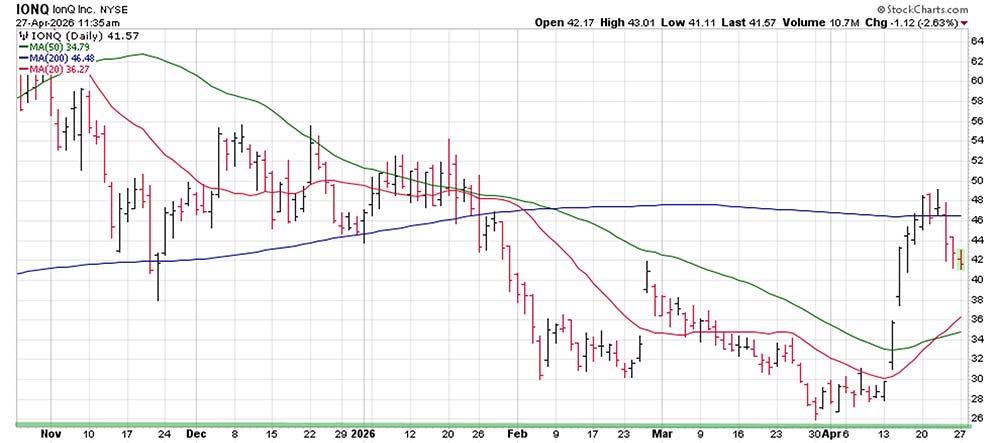
IonQ has already experienced a meaningful pullback from its highs. The initial wave of enthusiasm has cooled, weak hands have been shaken out, and the stock is beginning to stabilize. That creates a cleaner technical setup.
Instead of focusing on the current price, the priority is identifying where institutional demand showed up during the last decline. Those levels become my reference points.
Selling puts well below those zones allows me to position for a worst-case scenario that may never materialize. If the stock revisits those levels, I’m buying into proven demand.
If it doesn’t, I collect the premium and move on.

Stock #2: D-Wave Quantum
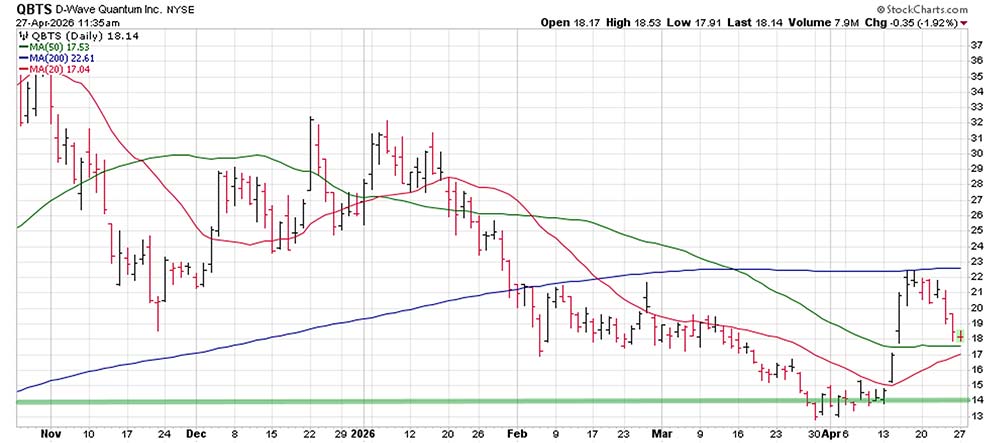
D-Wave Quantum takes volatility to another level. The stock has already demonstrated its ability to bounce all over the place when the market sees selling, but that’s the opportunity here, and only if the trade is structured correctly.
I’m identifying where the last major selloff found support, then moving my strike price well below that level.
This creates a buffer against another sharp drawdown, which is not only possible but likely in an industry like this. From a premium-selling perspective, it’s exactly what I want.

Stock #3: Alphabet
Alphabet plays a different role. While IonQ and D-Wave represent high-risk, high-upside quantum exposure, Alphabet offers a more stable entry point into the same long-term theme.
I described Google as the in-the-money call in quantum computing because of its broad diversification beyond the sector. But like IBM, Google will be a major player in quantum computing, which means significant upside potential.
That stability changes my approach. Because of its balance sheet strength, diversified revenue, and institutional ownership, I don’t need to push strike prices as far out of the money.
Premiums may be lower, but I’m trading that for a higher-quality underlying asset. If assigned, I’m not buying speculation. I’m adding a core long-term position.


YOUR ACTION PLAN
Quantum computing is not a stable sector. It’s early-stage, speculative, and driven heavily by sentiment. That combination creates wide price swings, and those swings are what generate premium.
By defining my entry price in advance and getting paid to wait, I shift from reacting to the market to controlling my participation in it.
More from Trade of the Day

Gold Just Went on Sale – But the Reason Won’t Last
Jul 17, 2026

The Market Feels Different. Here’s What To Watch.
Jul 16, 2026

Saddle Up Sally! The Hottest Trend in Retail
Jul 15, 2026