The Breakthrough That Made Humanoid Robots Real

Robotics is the next Apple moment.
I said that yesterday, but what I didn’t say was why it’s finally real.
Today I want to tell you what made it possible. The technical breakthrough that unlocked humanoid robots quietly went into production this year.
It’s called edge AI. And without it, none of this works.
The 30-Year Problem
A robot operating in the real world has to make decisions in milliseconds. A human grabs a falling glass before it hits the floor because the brain processes the situation locally and acts.
A robot trying to do the same thing through the cloud is dead before it starts. By the time the data leaves the robot, hits a remote server, gets processed, and sends back instructions, the glass is shattered on the ground.
Cloud AI is fast for chatbots. It is useless for physical robots.
The solution is putting the AI brain on the robot itself. That’s edge AI.
And until very recently, nobody had a chip small enough, powerful enough, and efficient enough to run a real AI model directly on a robot in real time.
Nvidia solved it.
A Single Piece of Silicon
The new Jetson Thor module went into production this year. It delivers more than 2,000 trillion operations per second of AI computing power, in a unit small enough to fit inside a humanoid robot, drawing only as much electricity as a single light bulb.
That single piece of silicon is what made every major humanoid robot announcement in 2026 work. Companies like Boston Dynamics, Humanoid, NEURA Robotics, Franka, Caterpillar, and LG Electronics are all shipping new robots with the Jetson Thor brain.
This is the iPhone-moment-to-iPhone-product pivot.
Two years ago, AI was something you used by typing into a website. Today, it’s something that walks into a warehouse, picks up a box, and puts it on a shelf.
The same model that wrote your kid’s or grandkid’s college essay last year is now driving an autonomous forklift through GXO’s logistics centers. That transition happened because edge AI got cheap, fast, and small enough to put on the robot.
Now the question is how to invest in it.
Forget the Obvious
You can buy Nvidia. That’s the obvious play, and it’s a fine one. But Nvidia is already a $4 trillion company, and most of its growth right now is still in data centers, not robotics.
The robotics boom will lift Nvidia, but it will also lift dozens of smaller, specialized companies building specifically for this physical AI moment. The single-name play captures one slice of the story.
The whole-sector play captures it all.
That’s where the Global X Robotics and Artificial Intelligence ETF (BOTZ) comes in.
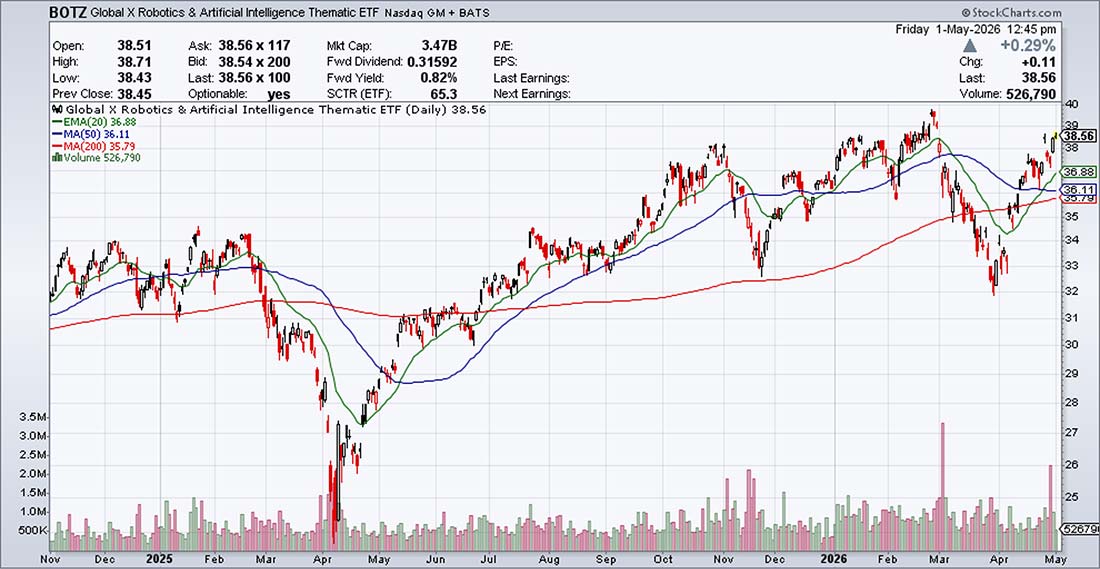
BOTZ holds 33 of the most direct robotics and AI plays in the public market, with Nvidia as the largest position at about 8% of the fund.
After that, the portfolio opens up to names most investors have never even heard of.
Intuitive Surgical dominates the robotic surgery market, while ABB, the Swiss automation giant, builds factory robots for nearly every major manufacturer on earth.
Keyence and Fanuc are the Japanese leaders in industrial robots and machine vision. Horizon Robotics builds chips for Chinese autonomous driving, and AeroVironment is the U.S. specialist in drones and defense robotics.
The fund is 47% industrials and 33% technology, which is the right mix for where this theme actually lives.

YOUR ACTION PLAN
Robotics is not just a tech story. It’s an industrial transformation story powered by tech, which is exactly how the BOTZ portfolio is constructed.
Just today, META announced it is buying Assured Robot Intelligence to help it build humanoid tech.
For investors who want exposure to the entire physical AI buildout without having to pick the one perfect winner, BOTZ is the clean way to do it.
I’ll be sharing what I think is the single best stock in this space in the coming days.
It’s a name that gives you direct exposure to the edge AI breakthrough, with a setup Wall Street is not paying attention to yet.
Until then, BOTZ is on the watchlist.
More from Trade of the Day
Gold Just Went on Sale – But the Reason Won’t Last
Jul 17, 2026
The Market Feels Different. Here’s What To Watch.
Jul 16, 2026
Saddle Up Sally! The Hottest Trend in Retail
Jul 15, 2026