Good Debt vs. Bad Debt: How to Spot the Companies About to Blow Up

Debt isn’t always the enemy people make it out to be.
Think about your own life for a second. The loan on your car is good debt, because that car gets you to work and the work pays you back.
The balance still sitting on your credit card from a vacation you took last year is bad debt, because the trip is over, your tan lines are gone, and you’re still paying for the memory.
It’s the same borrowed dollar in both cases, but one bought you an engine, and the other just left you with post trip depression and a massive bill.
Companies work the same way, and telling the two apart is one of the most valuable skills an investor can build.
Good corporate debt funds something that earns more than the debt costs. Bad corporate debt funds a dream that has to come true just for the company to break even.
The problem is that from the outside, on a good day, the two can look identical.
Both companies are spending big, both are building, and both have a story about the future.
Wall Street packages all of that spending and calls it ambition.
What Wall Street doesn’t show you is how the spending got paid for.
That part is the sausage, and a lot of the time, the sausage is debt.
So, how do you check?
You don’t need a finance degree…
You need one question answered: can the company pay what it owes out of the money it earns?
The cleanest way to see this is the interest coverage ratio.
Take a company’s operating earnings and divide by its interest payments, and you get how many times over it can cover the interest on its debt.
Above two or three times is comfortable. Down near one, the company is one bad quarter away from trouble.
Then check one more number: the net debt-to-earnings ratio.
It answers a simple question: how many years of earnings would it take to pay the debt off?
Under three is generally fine. Climbing well past that is a warning, especially for a company in a young and unproven business.
This is the part that trips people up. A company can look cheap and still be dangerous.
It can show growth, a low price against earnings, and a story everyone loves, while it sits quietly buried in debt it can’t service.
Cheap does not mean safe.
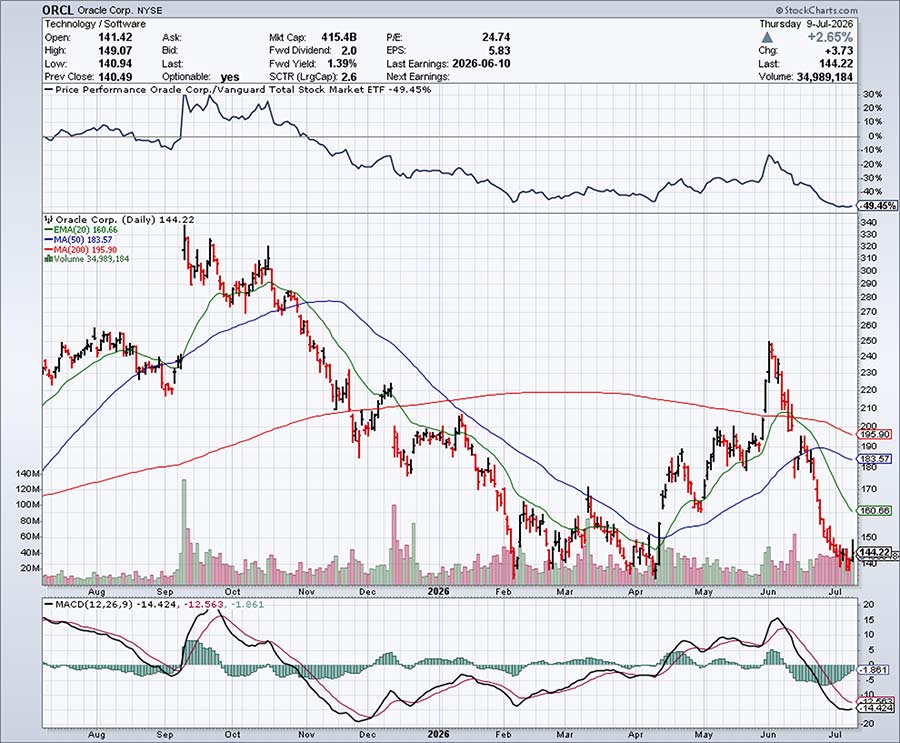
Oracle (ORCL) is a textbook example of the bad kind. The company is spending enormous sums to build AI data centers.
The market cheered it for a while, then investors looked at the bill.
Oracle is carrying around $156 billion in debt against roughly $31 billion in cash. It’s burned through about $24 billion more cash than it took in, and its debt sits near four times earnings, high for its industry.
To keep the buildout going, it sold stock to protect its credit rating, which is a tell all by itself, because it means the borrowing alone could no longer carry the weight.
By the time the market was done repricing all of it, the stock had been cut roughly in half.
To be fair, Oracle could still emerge victorious, but its debt laden balance sheet says that there are better risk/reward plays out there.
And the 50% haircut in share price reflects that as well.
If we compare Oracle to the other giants doing the same building, it starts to look even worse.
Microsoft (MSFT) and its peers also borrowed heavily to fund their AI push, but their earnings dwarf what they owe, so their debt is a fraction of a single year’s profit.
Same activity, opposite balance sheet.
One is good debt funding growth it can pay for, the other was a bet that had to pay off on schedule or else.

YOUR ACTION PLAN
When too much money floods into one hot sector, the borrowers who can’t cover their debt out of real earnings are the ones who break first.
It happened with oil and gas near the peak, with the dot-coms, and with housing in 2008. The names change and the wreckage rhymes.
So before you put another dollar to work, run the check…
Pull up the debt, set it against the earnings, and ask the car-versus-vacation question. Is this borrowing buying an engine, or just a bill?
Get that one answer right, and you’ll dodge the companies most likely to blow up long before the market gets around to punishing them.
More from Trade of the Day

Gold Just Went on Sale – But the Reason Won’t Last
Jul 17, 2026

The Market Feels Different. Here’s What To Watch.
Jul 16, 2026
Saddle Up Sally! The Hottest Trend in Retail
Jul 15, 2026