Three Companies Make the Turbines AI Needs.
Hyperscalers are booking GE Vernova gas turbines into 2030.
They are the cloud and AI giants like Microsoft, Amazon, Google, and Meta, and they are building most of the data centers AI runs on.
The power they need to operate those data centers does not exist yet.
That is the trajectory CEO Scott Strazik laid out for investors on the Q1 earnings call last month. By the end of this year, the company will have every delivery slot through 2030 booked. They are on pace.
Three companies on Earth can build large-scale gas turbines: GE Vernova, Siemens Energy, and Mitsubishi Heavy Industries.
Even if all three execute on their planned capacity expansion, total global output rises only 20% to 25%.
That is nowhere near enough to meet AI infrastructure demand.
This is the bottleneck nobody is pricing in.
The compute side of the AI buildout has scaled with the chip cycle, but the generation capacity behind the grid never caught up.
GE Vernova booked $2.4 billion in data center equipment orders in Q1 2026 alone, more than the company booked across all of 2025.
Total electrification orders doubled to $7.1 billion.
Combined gas turbine backlog and slot reservations grew from 83 gigawatts to 100 gigawatts in three months.
A backlog is contracted orders that the company has not yet delivered, and slot reservations are binding production slots that customers pay for years in advance.
To put 100 gigawatts in perspective, that is enough generating capacity to power roughly 75 million American homes. The company has every gigawatt under contract already.
Microsoft is using output from a Chevron-Engine No. 1 partnership for its AI data centers. That deal is one of dozens. Customers signing the orders are negotiating the delivery slot, not the price.
When supply is fixed, and demand is contracted years ahead, the company holding the equipment has pricing power that almost nothing else in the public market has right now.
That is what eventually shows up in the chart.
GEV is a textbook TPS setup, which is the three-part framework I trade by: Trend, Pattern, Squeeze.
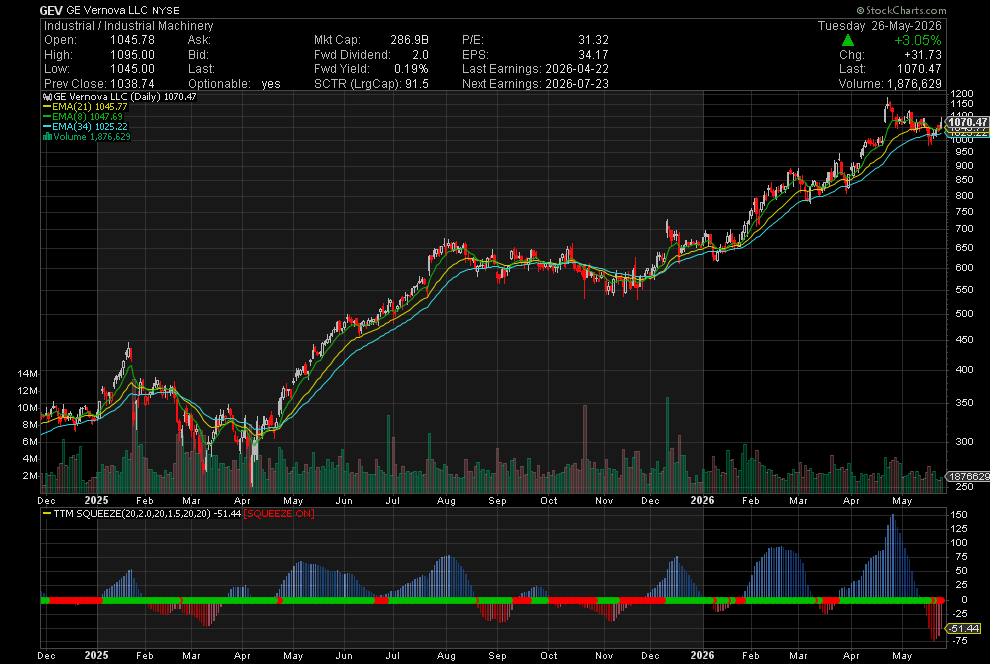
The trend is up on the daily and weekly timeframes. The 8, 21, and 34 EMAs (exponential moving averages, which smooth out daily price noise to show the underlying direction of the move) are stacked with the shorter periods above the longer ones, and the price is sitting above all three.
GEV has run from $300 to over $1,000 in the past eighteen months without breaking a single trend signal that the system would flag.
The pattern is a tight consolidation above the prior breakout zone. After the run from $700 to $1,150 earlier this year, GEV pulled back, held the trend, and is now coiling at the highs.
The squeeze is on. The TTM squeeze is a volatility indicator that fires when the daily price range compresses into a tight band, historically signaling a fast move in either direction.
On GEV right now, the squeeze histogram is right at the zero line, which is where the release tends to be sharpest.
Your Action Plan
Setups like this amplify the technical move when the fundamental story is already in place. GEV is not a story stock chasing a quarterly narrative.
Customers have signed multi-year contracts that run through 2030.
A clean breakout gives funds rotating into AI infrastructure their cleanest entry into the AI power theme.
When GEV fires, the alert goes out in real time inside Daily Profits Live. Every morning, we walk through the watchlist live and execute the trades on the screen.
More from Wake-up Watchlist



Healthcare Is No Longer Dead Money.
Jul 23, 2026

3 Stocks At All-Time Highs Just Got Downgraded
Jul 22, 2026