EVERY Options Trader Should Use this Simple Strategy

Here’s one of the biggest misconceptions in modern investing: Building meaningful wealth requires a large amount of capital.
You’ve been conditioned to believe that, but in reality, one of the most effective ways to diversify and gain leveraged exposure to long-term growth trends is through a simple options strategy: LEAPs.
LEAPs, or Long-Term Equity Anticipation Securities, are options contracts with expiration dates that extend far into the future, often one to two years out.
They are not exotic or overly complicated. In fact, they are arguably the simplest long-term options strategy available… and for my money, the first strategyanyone interested in options should learn.
The reason is simple.
LEAPs allow us to control shares of a stock for a fraction of the cost of buying the stock outright. This creates flexibility, leverage, and diversification opportunities that many retail traders would otherwise never have access to.
Starting Small with LEAPs
Most investors look at a stock like NVIDIA or Tesla and assume they need tens of thousands of dollars to meaningfully participate in the trend.
And if you were buying the underlying stock, that would be true… but LEAPs change that equation entirely.
Instead of committing full capital to 100 shares, you can use long-dated call options to control the same 100 shares for a much smaller amount.
For example, buying 100 shares of Tesla (TSLA) stock today would cost you around $40,000… buying a single longer-dated TSLA call option (say, June 2027) would cost less than $100.
This strategy gives exposure while saving cash for additional opportunities.
That last point matters more than most investors realize.
The average retail portfolio is often poorly diversified because lots of capital gets trapped in a small number of stocks.
A $10,000 account might only be able to buy two or three meaningful positions outright.
LEAPs create the ability to spread exposure across multiple sectors, themes, and growth opportunities without breaking the bank.
That does not mean LEAPs are risk free.
They’re still options. They still expire. And time decay still matters. But compared to short-term options trading, which is often driven by volatility spikes, earnings reactions, and rapid price swings, LEAPs are designed to give trends time to work.
This is why they are such an effective entry point into options trading.
LEAPs Focus on the Trend, Not the Volatility
Instead of trying to predict what happens next Tuesday, investors can focus on where an industry or company may be headed over the next one to two years. That dramatically changes the mindset from short-term speculation to long-term positioning.
One of the best examples of this setup right now is Joby Aviation, Inc. (JOBY).
JOBY represents one of the most speculative but potentially transformative industries: electric vertical takeoff and landing aircraft (eVTOLs).
The sector remains early stage, volatile, and highly emotional, but the long-term outlook remains bullish as companies transition from startups into developmental growth phases.
That volatility is exactly what makes LEAPs so attractive.
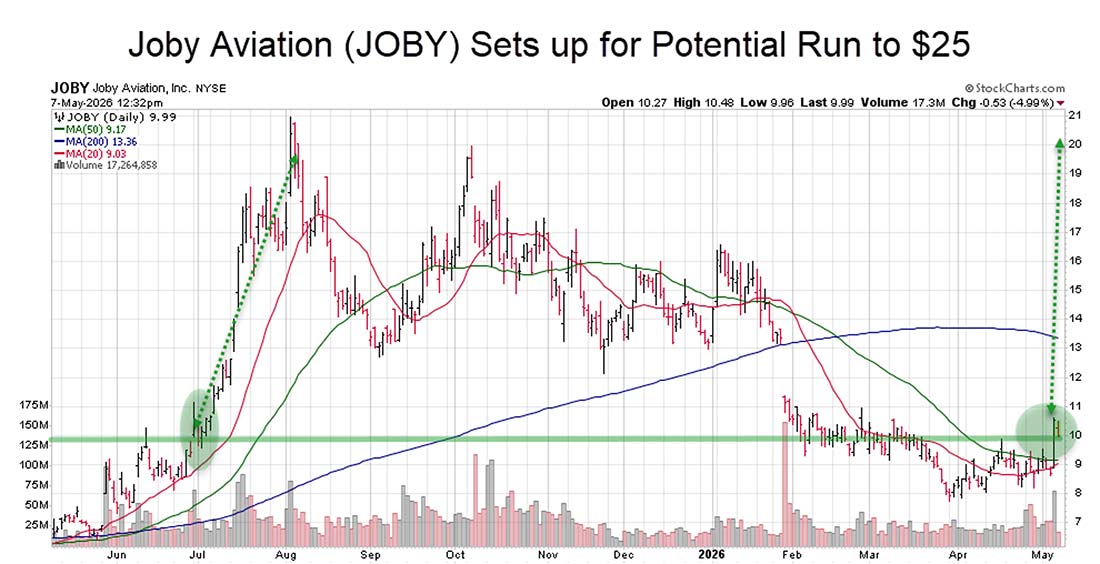
JOBY appears to be in a long-term institutional accumulation phase, where volatility and sharp pullbacks create opportunity rather than signal trend failure.
Technically, the stock continues to stabilize around key moving averages while maintaining a longer-term pattern of higher lows.
At the same time, institutional interest in the eVTOL industry continues to build as investors seek exposure to the next generation of transportation technology.
That combination of volatility, long-term growth potential, and improving technical structure creates an ideal setup for LEAPs investors.
LEAPs Offer a Diversification “Bonus” Benefit
Following the company’s positive earnings results this week, JOBY shares popped above the psychologically significant $10 price, suggesting investors may begin accumulating the stock again.
It dipped back down to around $9.75 today, but breaking the $10 barrier is still important.
After all, buying 100 shares of JOBY may not seem expensive today at around $10 per share (~$1,000). But that misses the broader point of how LEAPs can scale a portfolio.
Rather than spending $1,000 buying the stock outright, you could purchase a long-dated in-the-money or near-the-money LEAP call option extending into 2027. That contract controls 100 shares of stock for a fraction of the capital.
The advantage is obvious.
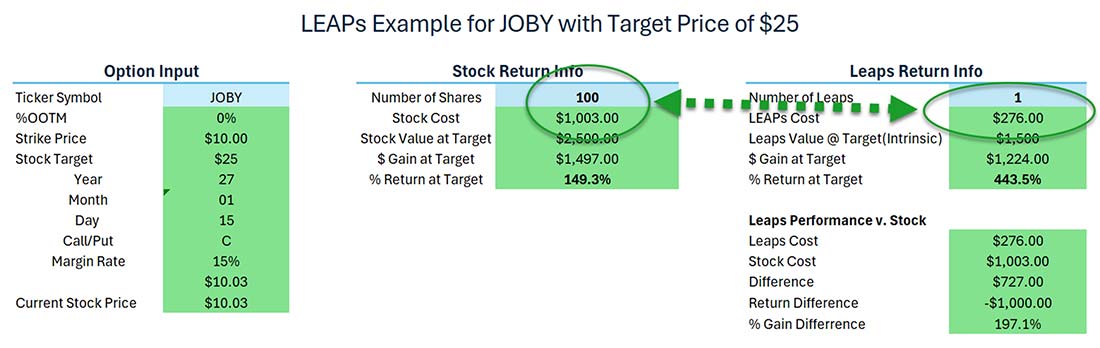
If JOBY experiences a sustained multi-year trend higher to a price target of $25, the percentage return on the LEAP can dramatically outperform the stock. This is due to the embedded leverage that LEAPs offer.
Meanwhile, the reduced upfront capital — $276 for one LEAPS contract vs $1,003 for the same 100 shares of JOBY — allows the investor to build additional positions elsewhere.
But that’s only part of the real power of LEAPs.
They’re not simply about leverage. They’re about portfolio efficiency.
A $10,000 portfolio could build holdings in dozens of stocks using LEAPs… instead of just a few using cash positions.
This becomes even more important in speculative growth environments with high volatility. Higher volatility often increases option premiums, but long-dated contracts provide enough time for trends to mature and institutional positioning to develop.
Leverage is Key
This is where the leverage advantage of LEAPs becomes obvious.
Buying 100 shares of JOBY at roughly $10.03 would require about $1,003 in capital.
Meanwhile, an at-the-money January 2027 $10 LEAP on JOBY can provide similar upside exposure for just $276.
If JOBY rallies to $25 before expiration, the stock position would be worth approximately $2,500, generating a gain of about 149%.
The LEAP, however, would carry an intrinsic value of roughly $1,500, producing a return of more than 440%. That’s the power of strategic leverage.
You can control the same 100 shares with significantly less upfront capital, allowing you to diversify into additional opportunities.
Bonus, if you want to exchange the LEAP for 100 shares of stock you can do so at the strike price of your option, $10, regardless of what JOBY shares are trading at.
Are you seeing why I love this strategy?
Volatility Creates Opportunity for LEAP Investors.
Instead of trying to perfectly time every breakout, pullback, or news headline, long-dated options provide time for the broader investment thesis to play out. Exposure to transformational industries can be gained without committing excessive amounts of capital upfront.
That flexibility matters.
One of the biggest mistakes new options traders make is jumping directly into short-dated weekly contracts because they appear “cheap”.
I love to use the rule that “the ‘cheaper’ an option, the more correct my trade needs to be.”
In reality, those “cheap” contracts are often dominated by time decay and emotional trading behavior. Investors quickly discover that being directionally correct does not always translate into profits if the timing is wrong.
LEAPs solve much of that problem by extending your timeline.
Sure, you still have to worry about time decay. But working in a 1-2 year window means the majority of your time decay — the enemy of options owners — doesn’t begin to accelerate for months or even quarters.
This gives you the time to think strategically instead of emotionally when volatility does present itself.
That’s why this should be the first options strategy investors learn.
The structure is simple. The concept is easy to understand. And the risk profile is cleaner than many short-term strategies.
Most importantly, LEAPs teach us how to think about long-term positioning, trend development, volatility, and capital efficiency all at the same time.
LEAPs Bridge the Gap Between Investing and Trading.
LEAPs allow us to participate in long-term growth trends while using capital more efficiently than traditional stock ownership alone.
Whether the opportunity is speculative growth like JOBY, infrastructure exposure through GLW, or long-term nuclear energy expansion through NNE, LEAPs create a framework that allows smaller accounts to think bigger without taking on unlimited risk.
If you’re serious about learning options, this is where your education needs to start.
Click here or on the image below to begin.

|
More from Trade of the Day

Gold Just Went on Sale – But the Reason Won’t Last
Jul 17, 2026

The Market Feels Different. Here’s What To Watch.
Jul 16, 2026

Saddle Up Sally! The Hottest Trend in Retail
Jul 15, 2026