SaaS Crash Alert: Why Catching This Falling Knife Could Get Ugly

The damage being done to the Software-as-a-Service (SaaS) industry right now is not subtle… and it’s not just another routine pullback that investors can casually buy.
This is a structural shift, and investors are reacting to it the wrong way.
They’re trying to catch a falling knife. That’s always a mistake.
I’ve said it for years… Don’t try to catch the knife while it’s falling. You wait for it to hit the floor. You wait for it to stop bouncing. Only then do you step in.
Right now, investors are reaching out mid-air, and they’re going to get cut more deeply.
From Confidence to Caution
What’s happening reminds me of a very specific setup from more than 20 years ago…
Cisco (CSCO).
Just as Cisco became the largest company by market cap in the world, it did the unthinkable. It met earnings expectations.
No miss. No disaster.
But then John Chambers – one of my favorite CEOs of all time – started talking about challenges ahead, and that subtle shift – from confidence to caution – was all it took.
The stock rolled over. Not because of earnings, but because expectations had to reset. That triggered a waterfall move lower as investors realized the story they were pricing in was no longer intact.
I did well in that environment.
And I pay attention when markets start to feel the same.
That’s exactly what’s happening right now in SaaS.
AI leadership has started to weaken.
Microsoft (MSFT) is down sharply from its highs. Meta (META) has rolled over. Names like Nvidia (NVDA), Amazon (AMZN), and Alphabet (GOOG) have all been dragged lower as sentiment deteriorates.
These are still core AI infrastructure names, so they’ve held up better than most. But the direction matters.
And when leadership weakens, the next layer down gets hit harder.
That’s SaaS.
An Accelerating Threat
SaaS companies were early beneficiaries of the AI trade. They positioned themselves as the interface layer for automation and productivity gains. Investors bought that story aggressively, pushing valuations to levels that required near-perfect execution.
Now that same narrative is working against them.
Generative AI is no longer a feature – it’s a threat.
If AI can write code, automate workflows, and replace entire software functions, then the value of subscription-based software gets repriced lower.
That’s the core driver behind this selloff.
And it’s accelerating.
When companies like OpenAI and Anthropic began demonstrating real progress – especially in code generation – the market took notice.
The moment Anthropic showed that it could generate COBOL (common business-oriented language) code, it sent a clear signal that even legacy systems are no longer protected.
That matters.
COBOL sits at the core of banking systems, airlines, insurance platforms, and government infrastructure. If AI can operate at that level, long-term demand for traditional software tools comes into question.
At the same time, macro pressure is building. Higher rates, slowing growth, and tighter liquidity conditions are all working against high-multiple sectors like SaaS. These companies depend on future growth to justify their valuations, and when that growth becomes uncertain, multiples compress quickly.
That’s exactly what we’re seeing.
And yet, investors are still trying to buy the dip.
It’s a mistake.
We have not seen capitulation.
We have not seen panic yet.
We have not seen the crescendo moment where investors throw in the towel and say, “I’m done.”
That moment is what defines a real bottom.
Instead of fear, we’re seeing “hopium.” Analysts are calling for opportunity.
Media voices are stepping in to support the narrative. Investors are trying to get ahead of the turn.
That’s not how bottoms form.
This is where the Cisco example matters again.
Cisco peaked near $50 in 2000 and dropped to $40. Investors were told it couldn’t go lower.
Then it dropped to $30… “great opportunity.”
Then $20… “once-in-a-lifetime entry.”
In Cisco’s case it kept going.
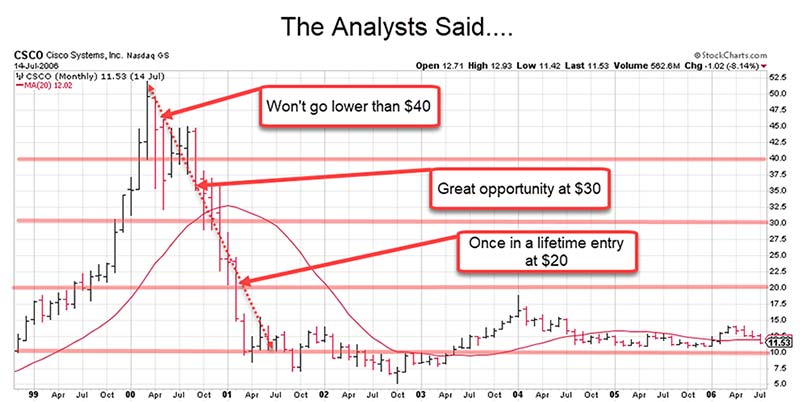
The real bottom didn’t come until investors stopped believing in the story. That’s the process. We’re in the middle of it now… not the end.
Here’s Your Signal
 |
I wrote about Salesforce (CRM) last week, describing investors as “whistling past the graveyard.”
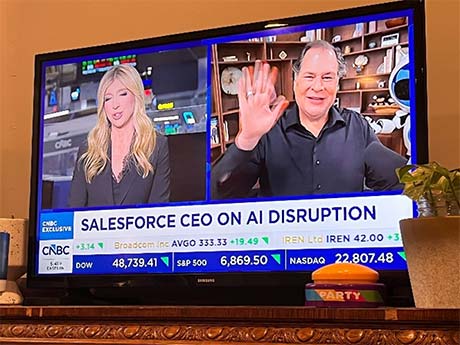
There was Marc Benioff, out in front of the cameras, smiling and waving as he said, “I can’t really understand it,” referring to the selloff in software.
That’s the moment in the picture on the right and that’s your signal.
When management teams can’t – or won’t – acknowledge what the market is clearly pricing in, it tells you that the reset isn’t complete.
That’s not confidence. That’s denial or hope. Neither mark bottoms for a stock.
The stock fell through its 50-day and 200-day moving averages, confirming a trend shift. It found temporary support near $175 and rallied to $200.
That’s not strength.
That’s a dead cat bounce.
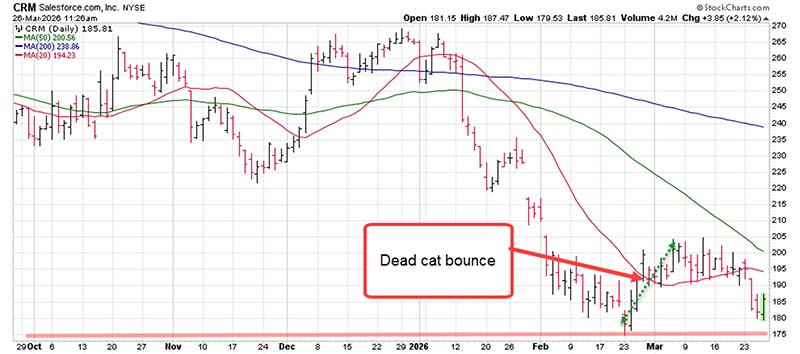
With no clear catalyst to sustain a move higher, the trend points lower. A break below $175 will accelerate selling pressure as investors begin to lose confidence.
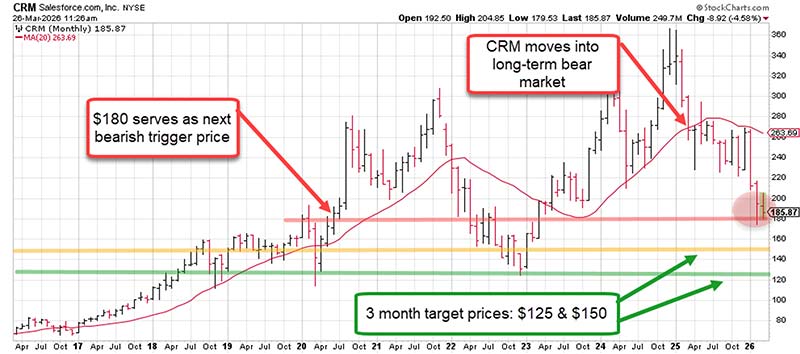
From a longer-term perspective, the next support zone sits between $125 and $150, implying another 20% to 30% downside.
That’s not extreme. It’s a rational expectation with the bearish trends that are in place clashing with hopeful sentiment.

YOUR ACTION PLAN
There’s no need to get fancy with this setup. When you have a strong trend working in your favor, the goal is to get paid on the move, not on hope.
This is a straight put strategy.
With downside pressure building and no clear catalyst to reverse the trend, the smart move is to buy time – more time than you think you need. That gives you room to absorb short-term volatility while staying focused on the larger move.
In this case, I’m looking at put options expiring June 18.
That lines up with the trend and gives enough runway for the setup to play out.
Strike selection matters too.
There’s no need to chase far out-of-the-money contracts hoping for a collapse. Instead, position just outside the money so you get paid as the trend develops.
That’s why I like the $180 puts.
They’re roughly 3% to 4% out of the money. A break below $180 takes out recent support and opens the door for accelerated selling.
That’s when investors start to lose confidence and when these options begin to move, which means acceleration to the downside.
The premium is around $12.35, or $1,235 per contract as I write this.
It may feel expensive, but you’re paying for time. After all, one of my rules of investing is “Don’t buy cheap options.”
Running out of time on an option just before the stock hits your target is one of the most common mistakes traders make.
A move to $150 gives this option an intrinsic value of $3,000, that’s a 140%+ return.
If selling accelerates toward $125, that same contract is worth roughly $5,500, pushing returns above 300%. That’s how you get paid in a trend.
There will be rallies, but they should be short-lived.
If Salesforce breaks back above $200 and holds that level for more than three days, the setup is invalidated.
No debate, no hope, straight discipline.
And that brings us back to the bigger picture.
Stop trying to catch the knife.
Wait for the trend to be completed and for investor sentiment to break. More importantly, wait for the crescendo.
Because the real bullish opportunity shows up when investors stop believing.
We’re not there yet.
For more ideas like CRM, be sure to subscribe to our YouTube Channel.
Note: Monument Traders Alliance Co-Founder Bryan Bottarelli just capitalized on one of these short-term surges in Salesforce. He used his brand-new Stock Flip Scanner to generate a quick gain earlier this week.
Look at what one of his followers said yesterday…

These countertrend moves are real and they also provide great short-term opportunities, but they don’t change the bigger picture.
They’re noise inside a downtrend.
More from Trade of the Day

Gold Just Went on Sale – But the Reason Won’t Last
Jul 17, 2026
The Market Feels Different. Here’s What To Watch.
Jul 16, 2026
Saddle Up Sally! The Hottest Trend in Retail
Jul 15, 2026