Nvidia’s Death Cross and the SpaceX Effect

We say “I’ve never seen anything like this” a lot in this business. But this time I mean it.
I was sitting at my desk on Monday, following the SpaceX IPO filing, doing some math. The sheer size of the IPO is like none the market has seen, and there’s a kicker that makes the timing even more important for Nvidia specifically.
Late June is shaping up to be an event the market has never seen before. One that has the potential to reshape indices, ETFs, and retail portfolios in a single strike of the opening bell.
But before that catalyst arrives, Nvidia has a much more immediate issue to deal with.
The stock is running into a set of technical challenges that are putting it in position for another 10-15% downside move as momentum continues to deteriorate.
Nvidia’s Technical Structure Is Breaking Down
The most important shift at Nvidia right now is the development of a lower-highs, lower-lows pattern.
This emerging pattern is one of the strongest signals of weakening momentum. It shows that buyers are no longer willing to step in at higher prices, while sellers are becoming more aggressive on each rally attempt.
For more than five months, Nvidia traded within a well-defined range between $195 and $175. That range provided stability and created repeatable opportunities for traders as the stock moved between support and resistance. However, that structure has now broken down, and the range has shifted $20 lower.
The new trading range sits between $175 and $155, but even that range appears unstable.
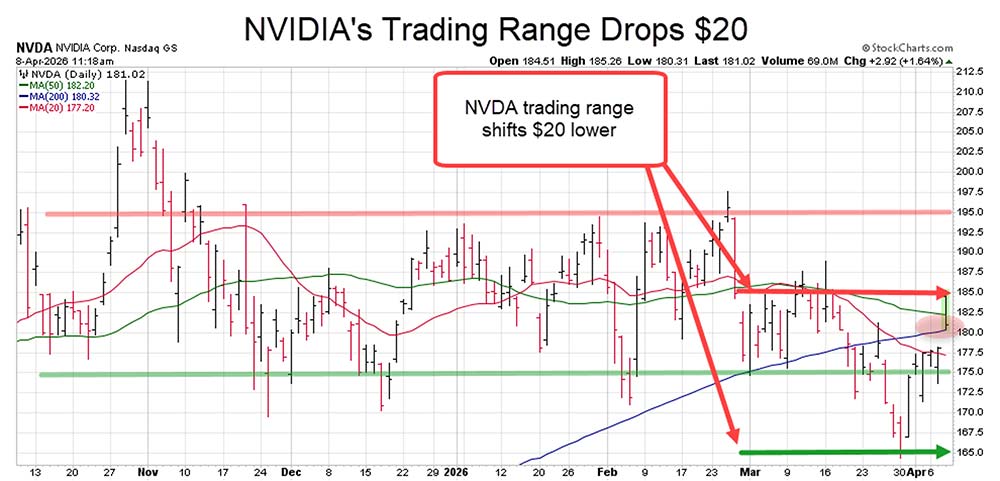
The reason is the stock’s 50-day moving average, which has flipped from support to resistance. Every rally attempt is now being capped at that level, preventing Nvidia from regaining upward momentum.
When a stock loses its range and fails to reclaim key moving averages, it often signals a larger trend shift rather than a temporary pullback.
The Approaching Death Cross
Pressure from the 50-day moving average is intensifying as it rapidly approaches the 200-day moving average. At the current pace, the 50-day is expected to cross below the 200-day within the next several trading sessions, completing what is known as a death cross.
A death cross occurs when short-term momentum breaks below the longer-term trend, signaling that sellers have taken control of the price action.
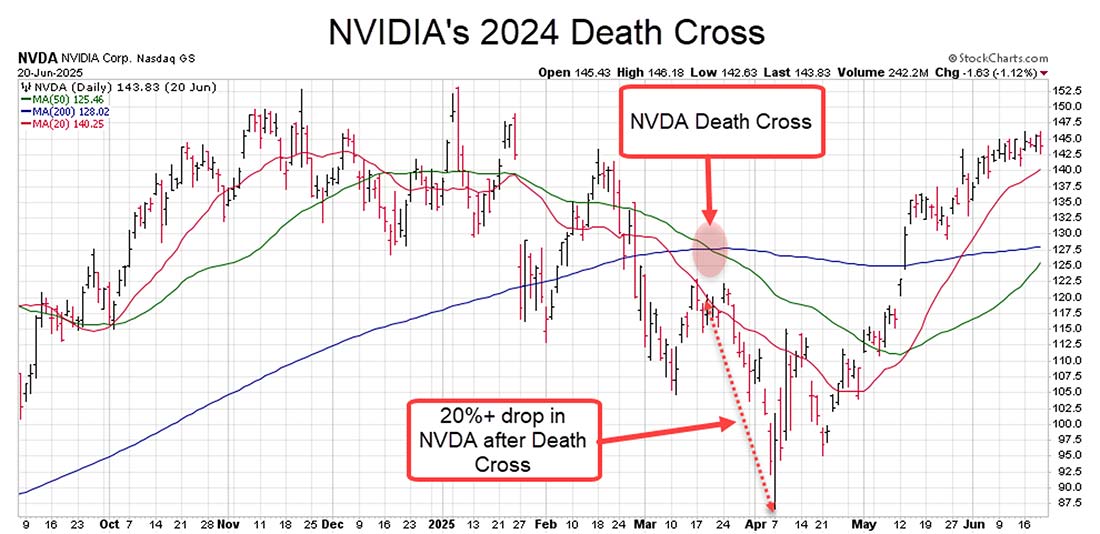
While it is not an immediate trigger for downside, it is a strong confirmation that the trend has shifted and that further weakness is likely over the following weeks.
The last time Nvidia formed a death cross was in March 2024. After that signal, the stock declined approximately 21% before finding a bottom in April.
The current setup is similar in both structure and timing, suggesting expectations should align with a comparable move rather than assuming a quick recovery.
The June Surprise: The SpaceX Effect
Now we return to the catalyst sitting just ahead of the market.
Seriously, this is something the market has never seen, at least not in my 30+ years of experience.
What makes the SpaceX IPO different from every other high-profile listing is the structural pressure it will create on existing capital.
The key difference lies in the sheer size of the IPO, expected to be valued at around $2 trillion.
But there’s more. 30% of the IPO is set to be allocated to retail investors, a jump from the typical 5% to 10% seen in most IPOs.
The retail allocation matters because retail investors will need to raise cash to participate.
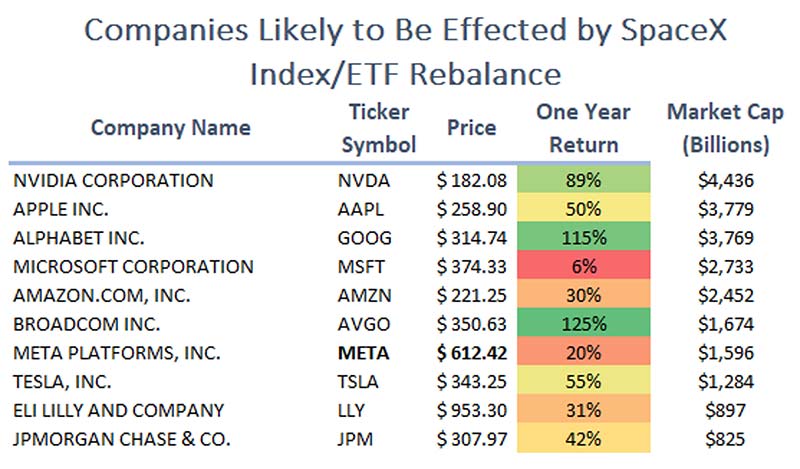
That process inherently creates selling pressure across existing holdings, particularly in stocks that have already delivered strong gains or are no longer market leaders.
Nvidia falls into that category as it begins to lose its edge in generating alpha.
At the same time, the expected size of the IPO means that SpaceX will quickly qualify for inclusion in major indices such as the S&P 500 and the Nasdaq-100. This introduces a second layer of pressure, as index funds and ETFs will be forced to rebalance their portfolios.
Note that the IPO date has not yet been set, but the S&P 500 index is scheduled to rebalance on the third Friday of June.
To accommodate a new large-cap addition, these funds must reduce exposure to existing holdings. That process often affects the largest and most widely held stocks, such as Nvidia, Microsoft, and others that dominate index weightings.
The result is a mechanical source of selling that is independent of fundamentals or sentiment.
When you combine retail-driven selling with institutional rebalancing, the outcome is additional pressure on Nvidia’s stock price at a time when its technical structure is already weakening.
Nvidia’s Key Levels and Downside Strategy
With all these factors in play, Nvidia’s pricing becomes critical. The stock must reclaim $185 to break the current pattern of lower highs and lower lows.
A sustained move above that level would signal that buyers are regaining control and could invalidate the bearish setup.
Failure to break above $185 keeps the current trend intact and points toward a near-term test of $165, particularly if market volatility increases.
A breakdown below $165 opens the door to $155, which aligns with the stock’s 20-month moving average, a key long-term support level, and the line that often separates bull markets from bear markets.
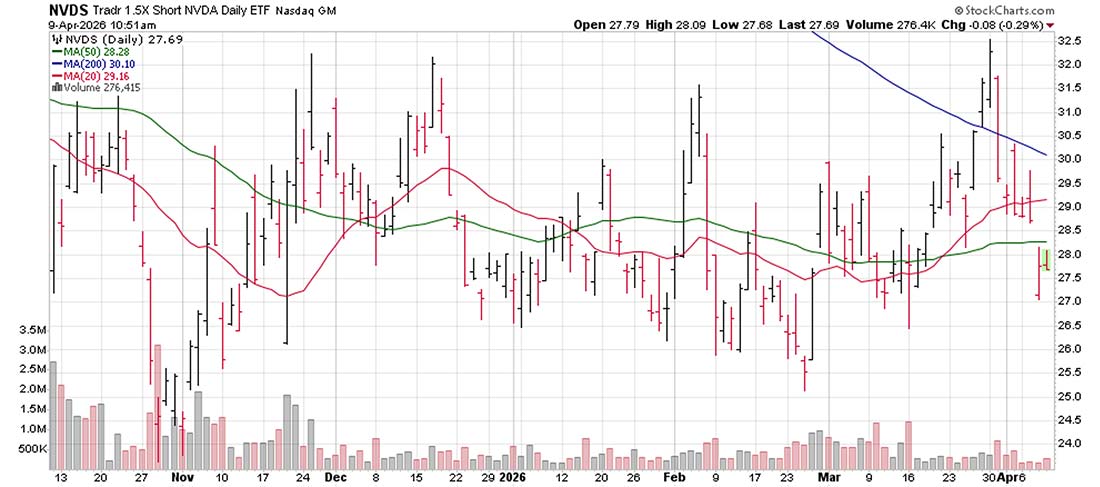
Traders looking to position for the downside can use the Tradr 1.5X Short NVDA Daily ETF (NVDS) or intermediate-term put options. I walk through both in detail in the video I share below.

YOUR ACTION PLAN
Nvidia’s technical structure is breaking down, the death cross is days away, and the SpaceX IPO is about to create a mechanical selling event unlike anything the market has processed before.
This is not about calling the end of Nvidia’s long-term story. It’s about recognizing that, in the near term, the path of least resistance is lower and positioning accordingly.
I break down exactly how to position for it in the video below.
Watch the full breakdown here.

More from Trade of the Day

Gold Just Went on Sale – But the Reason Won’t Last
Jul 17, 2026
The Market Feels Different. Here’s What To Watch.
Jul 16, 2026

Saddle Up Sally! The Hottest Trend in Retail
Jul 15, 2026